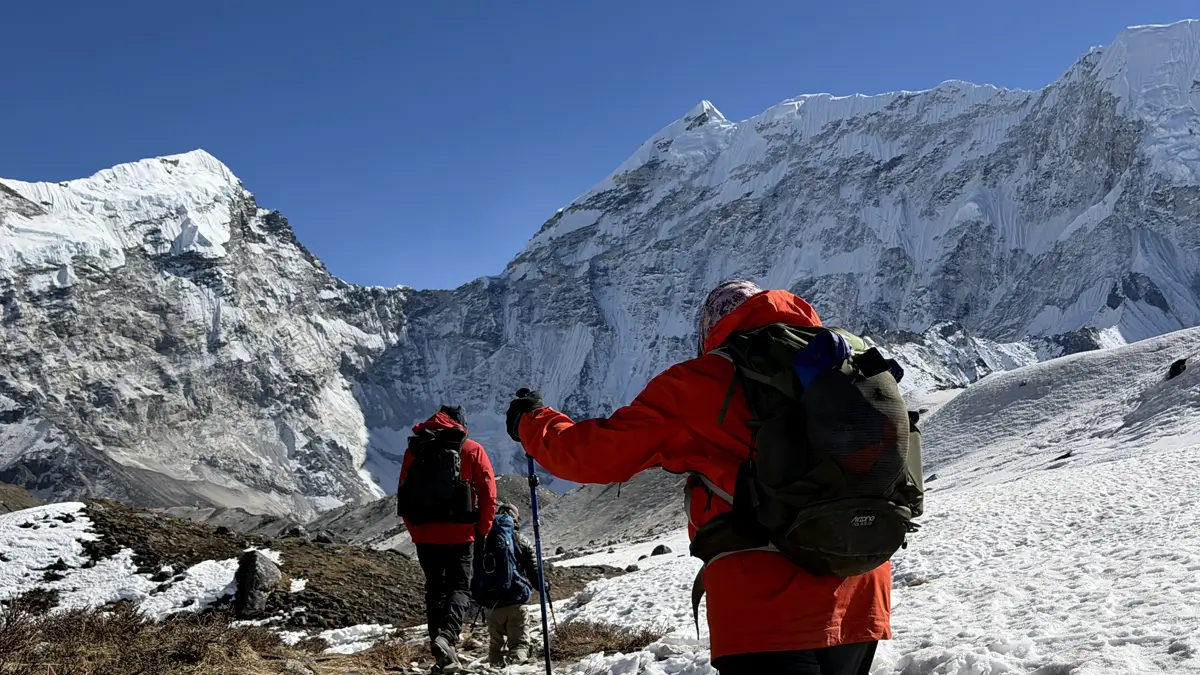
Top 10 Things to Know about the point where Earth meets sky: Mount Everest
Top 10 Things to Know about the point where Earth meets sky: Mount Everest
Updated on October 07, 2026
Mount Everest, the highest mountain in the world, standing tall against thousands of mountains on Earth, is undeniably one of the most fantastic attractions for mountaineers and adventurers across the globe. The gravitation that calls the daredevils is far beyond one’s explanation, ready to risk their lives to reach the summit point or at least capture the closest view from Kala Patthar (5,545 m - 5,644 m) or stand at its base camp (5,364 m).
The true symbol of triumph, adventure, human endurance, and exploration that has inspired generations of mountaineers, climbers, researchers, photographers, and travelers with its great height, extreme conditions, mind-blowing history, and mystery, from green boots and sleeping beauty to the Yeti. Here are the top 10 interesting things to know about Mount Everest in Nepal, including its location, height, real name, weather, and death zone.
What is Mount Everest's Real Name?
Most of the rocks at the summit of Everest are found to be made up of limestone dating back 450 million years, while the mountain itself is around 60 million years old, featuring shale, marble, and limestone. It was first identified by Sir George Everest in 1841. Initially named Peak 15, it was later renamed Mount Everest in 1865 after Sir George Everest, who served as Surveyor General of India, and he himself was not responsible for naming the mountain.
Either way, Mount Everest is the English name. Locally in Nepal, it is called the "Sagarmatha," translating to “above the sky” or “goddess of the sky," which in Tibet is the “Chomolungma” or "Qomolangma," meaning the mother goddess of the world or goddess mother of mountains. It is beyond just a peak; it is held extremely sacred. I.e., it has multiple names, each with distinctive meanings, while it grows a quarter of an inch each year.
Where Is Mount Everest?
If you are wondering about the location of Mount Everest, it sits precisely at 27.9881° N latitude and 86.9250° E longitude, serving as the natural border between Nepal and the Tibet Autonomous Region of China in the Mahalangur mountain sub-range of the Himalayas. 18 different routes for climbing, with two main ones from the South Base Camp (5,364 meters / 17,598 feet) in Nepal and the North Base Camp (5,150 meters / 16,900 feet) in Tibet.
Especially when the southern face sits inside Nepal’s Sagarmatha National Park in the Solkhumbu district and the northern face within the Tingri County of Tibet. Comparing the two, since Nepal offers a more straightforward trekking infrastructure and dynamic high-altitude culture along with proper acclimatization essential for making it to the Everest summit point, it remains the most popular gateway, including for other Everest Treks like the Three Passes, Gokyo Lakes, and Everest Circuit.
Who are the Mount Everest People?
As also mentioned above, the Everest expedition route is more accessible from Nepal, which at first includes trekking through the iconic Khumbu Valley following the footsteps of the legendary climbers Sir Edmund Hillary and Tenzing Norgay Sherpa (the first people to reach the summit of Everest in 1953) in the Everest region, where the Sherpas are greater in population. Nicknamed the Tigers of Snow, they are the real guardians of the Himalayas.
Studies have found that Sherpas’ muscle tissues can thrive at high altitudes with exceptional mountaineering skills, and they also possess profound knowledge of the mountains, eventually earning them the nickname "Tigers of Snow," especially when several Sherpas have set world records in mountaineering, such as Kami Rita Sherpa for summiting Everest over 30 times. Their simple yet content lifestyle is what makes the journey beyond the towering peaks.
Is the Mount Everest Yeti real?
Yet another thing that charms the curious minds towards Everest is the Yeti. A legendary creature from Himalayan folklore considered to be a large, ape-like creature covered in thick hair, often referred to as the “Big Foot”. While until today there are no official records of sightings, it has been part of the folklore for centuries, with Khumjung Monastery having said to house the scalp of a Yeti that you can observe during the visit.
Supported by reports of unusual footprints by locals and climbers, though the spotting may be rare, the fascinating legends describing it as a large, powerful, and human-like mountain guardian in high-altitude wilderness continue to inspire books, documentaries, movies, and expedition stories. Even the lowest chance of 0.99% of being one of the first people who may come across one, including the majestic snow leopard, adds to the thrill.
How Tall Is Mount Everest?
The official Mount Everest height is 8,848.86 m/29,031.69 ft above sea level, including the mountain’s snow and ice cap at the summit point, jointly announced by both Nepal and China in 2020, after a new measurement campaign which also resolved the disagreements caused by the light refractions. Measured from mean sea level (geoid) at the high Tibetan Plateau, this figure is what makes it the highest point on the Earth.
With the summit reaching deep into the upper atmosphere, where the oxygen levels drop significantly, with only ⅓ of what they are at sea level, and silence begins to speak louder than anything, you will be amazed that the elevation of Mount Everest continues to grow approximately 4 millimeters per year due to tectonic uplifts and can be further influenced by seismic activities like earthquakes, as they can shift the landmasses drastically.
On the Everest Trekking and Climbing Route in Nepal with Mountain Monarch
Understanding the Mount Everest Death Zone
The term 'death zones on mountains' refers to any altitude above 8,000 m/26,247 ft one has to journey through to make it to the summit points of mountain ranges measuring 8,000 m above sea level, such as Kanchenjunga (8,586 m), Lhotse (8,516 m), Makalu (8,463 m), Cho Oyu (8,201 m), Dhaulagiri I (8,167 m), and Manaslu (8,163 m), including Mount Everest (8,848.86 m/ the highest mountain in the world).
The significant drop in atmospheric pressure, which results in only ⅓ of the oxygen available at sea level, causes the human body to begin deteriorating. Khumbu cough can get persistent, and the risk of High Altitude Pulmonary Edema (HAPE) and High Altitude Cerebral Edema (HACE) rises dramatically. Extreme cold temperatures that can go lower than -40°C—no wonder climbers typically try to spend as little time as possible here.
The Story of Green Boots on Mount Everest
One of the tragic events that highlights the bitter truth of high-altitude rescue and how unforgiving the mountains can be is the green boots on Mount Everest. The nickname comes from the distinctive green boot that one of the fallen climbers was wearing, strongly believed to be Indian climber Tsewang Paljor from Ladakh, who was part of the historic 1996 Everest Expedition and sadly could not make it back.
Positioned in a limestone cave along the Northeast Ridge Route at an altitude of around 8,500 m, the severe cold and freezing conditions until this day have preserved the body over decades. While it is used as one of the major reference points during the Mount Everest climbing journey, it is for us to remember that each of them is someone’s family, friends, and aspirations, and approach them with respect rather than as a simple curiosity or tourist attraction.
The Mystery of Mount Everest Sleeping Beauty
On May 22, 1998, Francys Arsentiev became the first American woman to reach the summit of Mount Everest without supplemental oxygen with her husband Sergei Arsentiev. Separated during the descent, Francys was found the next morning alone and barely conscious. Due to extreme conditions for rescue, she tragically succumbed to her injuries on May 24, which remained in plain sight along the standard Everest Expedition for a decade until 2007.
A team of mountaineer Jangbu Sherpa, respectfully moved her body to a less visible location with a Buddhist sky burial ritual to provide dignity and privacy in 2007. But before that, her peaceful-looking position with one arm outstretched and her head pillowed on snow, as if implying it all was worth it, is what earned her the nickname "Sleeping Beauty." An inspiring story with a strong reminder that summiting Everest does not guarantee survival.
How Long Does It Take to Climb Mount Everest?
There is not a single answer to the exact duration of the climbing journey to Mount Everest peak height of 8,848.86 m. The summit day alone can take anywhere between 12 and 18 hours and is greatly affected by one’s training, preparation, hiking pace, and weather of that day, too, after months of high-altitude trekking and climbing to and from the Everest Base Camp. 60 days is the standard Everest climbing itinerary handpicked by professionals from Mountain Monarch.
A typical Everest Expedition itinerary of 60 days is one of the best, including for 2027 and 2028, from arrival in Nepal to departure. As per it, at first you trek towards the Everest Base Camp that remains busy throughout the years; thereafter, it is only when the actual climbing begins that you mind and stick to the practical tips of slow and steady wins the race. Be attentive while our well-trained and experienced climbing guide provides you with training, and follow their lead.
Environmental Challenges: Climate Change and Litter
With the increasing popularity of Everest climbing, a golden opportunity to conquer the top of the world has created significant environmental challenges. Climbers have already left 40 - 50 tons of waste behind, including oxygen bottles, food packaging, climbing equipment, and human feces. This is why the government of Nepal enforced a new rule that each climber must bring down 8 kilograms of waste on their descent to claim a 4,000-dollar deposit.
Campaigns such as the Everest 8848 Art Project turned 8 tons of rubbish from Everest into artwork to increase awareness about the situation, and cleanup expeditions have removed 100 tons of debris from the mountain since 2019. Likewise, since September 1st, 2025, the price of the climbing permit for Mount Everest has increased to USD 15,000 during the spring peak season, emphasizing quality tourism over quantity.
Conclusion
Often described as the roof of the world, the point where the earth truly meets the sky, the height of Mount Everest, from its sacred roots as Chomolungma in Tibet to the technical challenges of the Death Zone (8,000 m above sea level), continues to captivate the hearts and souls of those who dream of true adventure, including for the years 2027 and 2028. The monument of nature’s greatest grandeur and human capacity, the most beautiful and brutal at the same time.
The stories of Green Boots and Mount Everest's sleeping beauty unveil the unforgiving nature of the Himalayas. Then the success story of Sir Edmund Hillary, Tenzing Norgay Sherpa, and Kami Rita Sherpa reminds you of extraordinary human resilience and determination. Mountain Monarch, 4.6/5 ratings as per 51 Google reviews, from trek to Base Camp to attempt the summit itself; we are here to make your dream of an Everest trip come true. Contact us now!