Mera Peak: Climbing Difficulty and Who Can Join
Mera Peak Climbing is an unforgettable adventure to summit the highest trekking peak in Nepal. The climb to Mera Peak at an elevation of 6476 m (21247 ft) is physically demanding yet uncomplicated and straightforward. This Mera Peak Climbing is rated at an Alpine PD difficulty level. It takes three weeks to conquer the summit, crossing rugged terrain in the Makalu Barun region of easter Nepal. The less-trodden journey to Mera Peak trek has countless ups and downs, also known as Nepalese flats, which are perfect for proper acclimation before the summit push. The entire climbing journey to Mera Peak is around 145 Kilometers, including the day hikes, and offers a mind-blowing climbing experience in the Himalayas.
A healthy, strong person with prior trekking experience can join the adventure to climb Mera Peak in Nepal. No previous climbing experience or training is required to join the Mera Peak climb. But it is always better to start physical preparation and work out a month or two before you join the Mera Peak expedition. Our mountaineering guides schedule a tailor-made training course at Khare Base Camp before the summit push to take your skills to new heights. This practical training includes glacial walking, rope fixing, ascending, and descending. Your active participation in this climbing activity is essential to level up your climbing skills and safely conquer the majestic Mera Peak.
21 Days Mera Peak Climbing Itinerary and Cost for 2026 and 2027
The Nepalese Himalayan Odyssey of 21 days to climb Mera Peak begins with your arrival at Tribhuvan International Airport (TIA) in Kathmandu, Nepal, and trip preparation on the very next day. The official departure for the Mera Climbing is on the third day as you fly over to Lukla from Kathmandu and mark your arrival at the gateway of the Everest Himalayas, one of the top trekking destinations in the world, home to the top of the world, Mount Everest, facilitating several epic Himalayan trekking, hiking, and climbing routes. Among them, Everest Base Camp Trek and Everest Three High Passes Trek are popular ones, along with Island Peak Climbing and Mera Peak Climbing. The presence of monasteries, gompas, Chorten, and the stone Mani Walls reflects a deep-rooted Tibetan Buddhist influence, offering a spiritually enriching experience throughout the Mera Peak journey.
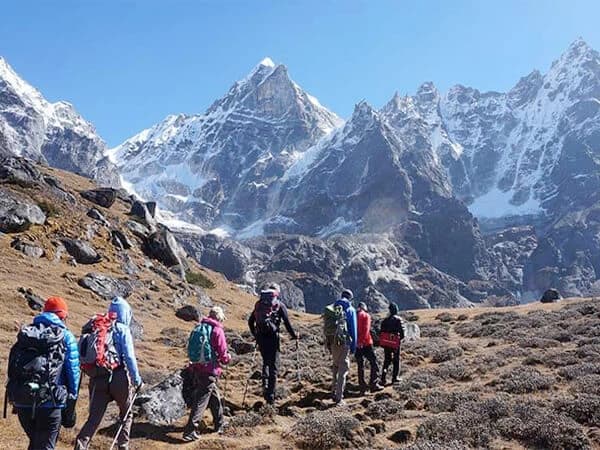
But there is a twist: while most of the trekking route of the Everest Region follows the footprints of legendary mountaineers Sir Edmund Hillary and Tenzing Norgay Sherpa, who are remembered in history for being the first successful climbers of the highest mountain on Earth, the Mera Peak Climbing Route diverges from Lukla and takes you to Puiya. From Puiya, you will continue trekking through Pangom, Nargin Dingma, Chholem Kharka, Panch Pohari, Khola Kharka, Hinku Valley, Kote, Thagnang, Khare, and eventually to Mera High Camp at an altitude of 5800 m. At Khare, a mountain guide from Mountain Monarch provides you with climbing training on a spare day dedicated to acclimatization to make sure you are well prepared both mentally and physically for the upcoming summit push to reach 6,476 m above sea level at Mera Peak.
Likewise, this thoughtfully crafted Mera Peak climbing itinerary ensures proper acclimation, embarking on an epic adventure through the most remote and breathtaking region, following the less-trodden Panch Pokhari trail to Hinku after the Lukla flight. Our Nepalese staff set up a high camp at 5,800 m to shorten the steep day on a rock offering a perfect shelter. In the center of the Everest Himalayas, Mera High Camp also has a truly stunning view of the entire region, a total feast for the eyes. What it has is indescribable in words; you have the best heavenly experience of climbing Mera Peak in Nepal.
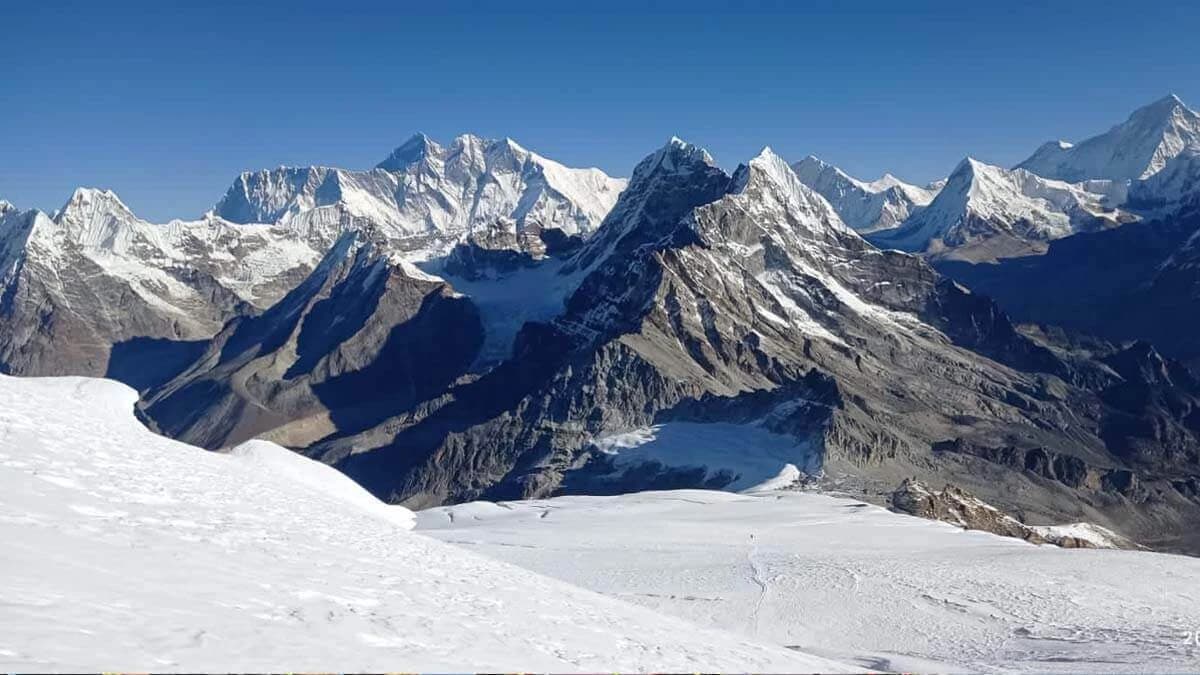
You approach the Mera Peak summit through the northern route. This is a steady climb with an outstanding mountain panorama in sight. The view from the summit is one of the finest in the Himalayas. Climbers would not be able to help themselves but hold their breath to see the five 8000-meter peaks in sight. From arrival to departure, the journey to Mera Peak in Nepal takes around three weeks. Spring, from mid-March to May, and autumn, in October and November, are the best times to scale this peak, and for a reasonable Mera Peak climbing cost, you would not regret being in touch with Mountain Monarch.
Our 21-day Mera Peak Expedition Cost includes expenses for all essential trekking logistics. The trip costs cover almost everything, including an experienced climbing guide and one porter per climber, National Park and climbing permits, Lukla flight, food, hotel and teahouse accommodation on the trail. We ensure hygienic and safe meals, including breakfast, lunch, and dinner. Thus, the cost of our Mera Peak climbing package is fair and inclusive.
Summit and Spare Day for Summit in Case of Bad Weather
Summit day on Mera Peak begins early, typically around 2 am, long before dawn breaks at High Camp (5800m). This early departure ensures you avoid the unpredictable afternoon weather in the Himalayas, which is highly unfavorable for a summit push, as visibility can shift from clear to obscured within minutes. The 6 to 8 hour ascent follows a more demanding, entirely snowy route. Because of the exposed icy surfaces, utilizing crampons and ropes is absolutely essential for your safety.
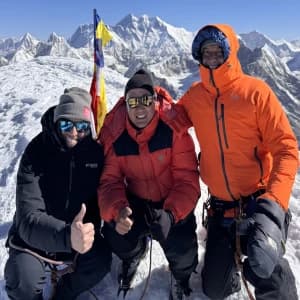
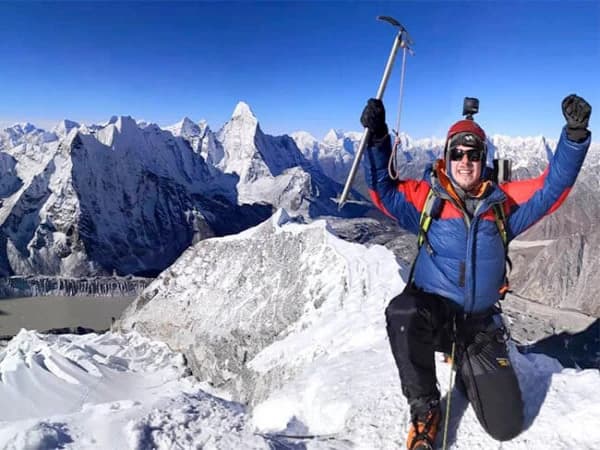
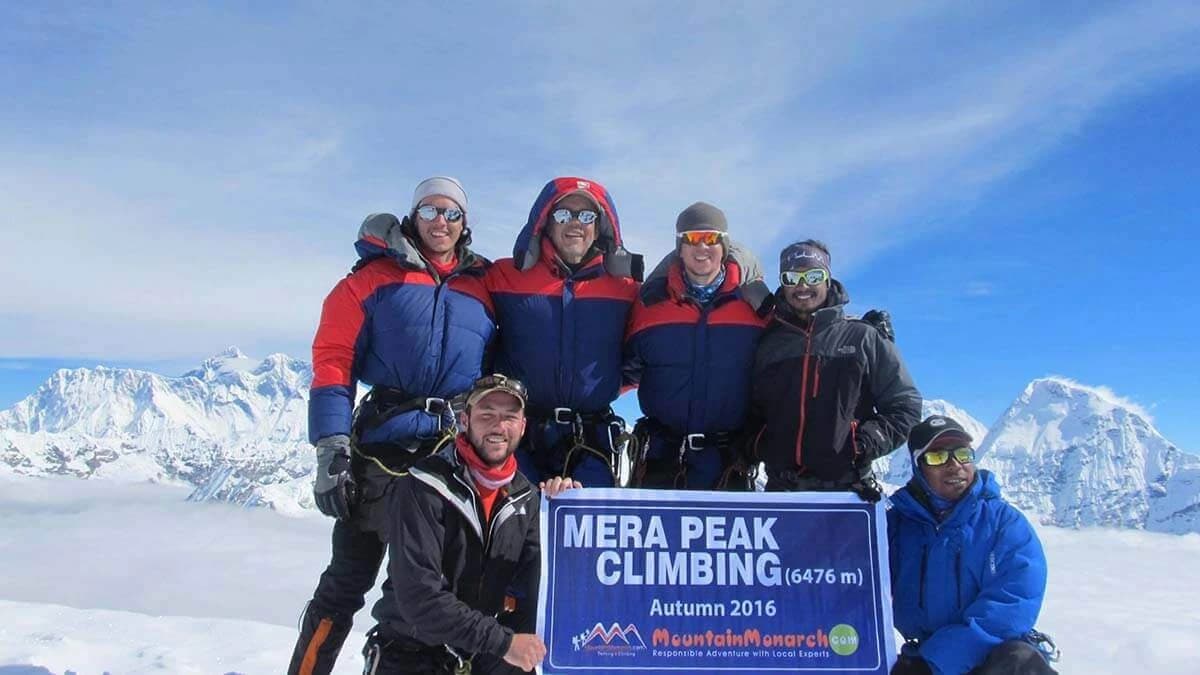
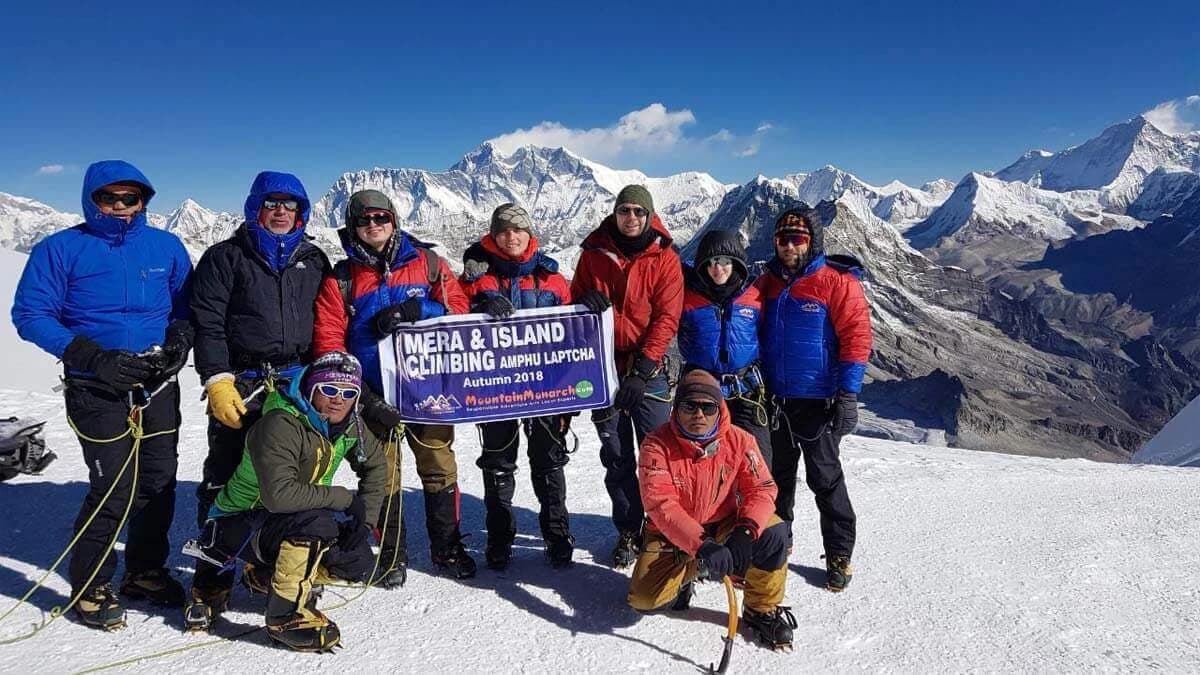
Once you reach the summit, the adrenaline hits you harder, with a deep sense of achievement at 6,476 m, set as a natural amphitheater where panoramic views of Everest, Lhotse, Cho Oyu, Makalu, and Kanchenjunga surround you in their finest form, bathed in dense snow. As you stand at the top of Mera Peak, every ascent and descent you make miles away from modern days, which is not everyone's cup of tea, becomes worth it, often overwhelming, bound to transform you from inside and out.
In addition, the Mera Peak Climbing itinerary from Mountain Monarch has an extra contingency day in case of bad weather. Unlike the typical itinerary of 15 to 16 days for climbing Mera Peak, our 21-day route ensures your flexible movement, letting you maintain your pace so that you do not develop symptoms of acute mountain sickness (AMS) and do not have to retreat. Often, trekkers and climbers opt for shorter itineraries due to low cost, unaware of the risks involved, whereas Mountain Monarch stands out for crafting the best itineraries so you have enough time to adapt and make it safe and sound, with a more enhanced experience.
Why Climb Mera Peak with Mountain Monarch
Mountain Monarch is a well-known leading trekking and expedition company in Nepal. It is the first choice for trekkers and climbers for quality service, reliable safety backup, responsible tourism, and well-organized logistical support throughout the company's 25 year journey. Your safety and convenience are our top priorities. We invest in professional personnel, high-quality climbing gear, and equipment to ensure a safe and successful climb.
Climbing Gear We Provide
We provide all the personal and group climbing gear on this Mera Peak climbing trip. This climbing gear is one of the major budgeting parts while planning a peak climbing trip. Since the establishment of our company in 2001, we have organized climbing trips where our trekkers and climbers used to bring their own expensive climbing gear with them. We noticed that guests were either buying expensive equipment they might use only once or bringing gear that was completely unsuitable. Our owner and MD, Pradip, personally meets each group member before and after the trek to gather firsthand experience and feedback from the climbers. All this valuable feedback has helped us improve our services by offering a full range of Personal and Group climbing gear, including climbing boots, crampons, harnesses, Jumars, figure-of-eight, etc. So, Mountain Monarch invests in branded climbing gear to ensure a hassle-free, cost-effective, and safe peak-climbing trip for our valued guests. This is one of our company's USPs when organizing peak-climbing trips in Nepal.
Licensed Holder Guide and One Trekker: One Porter
Experienced climbing guides and strong and reliable porters are the backbone of a successful expedition, including Mera Peak climbing. All of our climbing guides have completed advanced mountaineering training and hold climbing licenses from the Nepal Mountaineering Association (NMA). They are medically trained by KEEP and have decades of experience leading expeditions to Mera. Some of them have climbed Mera Peak more than 50 times so far.
We believe that responsible travel brings greater satisfaction once you reach the summit of Mera Peak and journey across the high Himalayan passes and Peaks. We ensure one porter for each trekker, so porters carry light loads on their backs. We are a local company that started a One trekker: One porter policy because we know the hardships and value of porters in this industry. It is always better to have manpower, if possible, in the mountains one trekker: one porter allows us to keep a dedicated porter behind every trekker that guarantees that the trip plan goes precisely as planned, who can serve as a layer of safety and support in case the team needs any help en route.
Full-board Meals and filtered Drinking Water
Enough nutritious food on the journey is important, as each of you will be walking from one place to another every day for more than two weeks, probably the most physically active days of your lifetime. We offer full-board meals featuring Nepali, Indian, and continental dishes, with our experienced guides monitoring the meals to ensure you have safe food. To safeguard the fragile Himalayan environment, we provide filtered drinking water on this expedition. Most adventure companies ask their guests to buy mineral water and limit the food to a single item per meal. We provide enough meals, but our only request to our guests is not to waste food; it can be seen as disrespectful, as they have carried these foodstuffs on their backs for weeks.
Safety on Trip: Oxygen and Satellite Phone
Proper safety planning is essential when climbing Mera Peak, as it exceeds 6400 meters. Our focus is on your safety with oxygen, a satellite phone, and a medically trained guide while you join the Mera Peak Climbing trip. Mountain Monarch guides are medically trained by Kathmandu Environmental Education Project (KEEP) and can deal with any situation on the mountain. Our supplementary oxygen cylinders safeguard trekkers at high elevation on this Mera trip. Our carefully planned itineraries are designed to support gradual acclimatization. The entire expedition team to Mera Peak has a satellite phone for communication in case of emergency while venturing in the high Himalayan valleys and passes. So, these are all the parts of the standard we have developed through the decades of leading our treks.
Our trip leader, C.P Rai, who has been leading trips for the last 3 decades, says that carrying oxygen and having supplemental Oxygen on hand is incredibly useful and often far more effective than a helicopter evacuation. Oxygen can be deployed instantly in any situation, whereas a helicopter evacuation strictly requires clear, daytime weather. Carrying a satellite phone in the wilderness of Mera Peak is essential for communication during bad weather or emergencies. Therefore, we ensure a satellite phone and supplementary oxygen in our must-have gear list on the Mera Peak expedition.
We regularly monitor and update the weather and risk assessments throughout the Mera Peak trek and climb. With these measures in place, you can venture on your journey with confidence and peace of mind. So, get ready to conquer new heights with Mountain Monarch, where we ensure paramount safety.
What has changed in Summiting Mera Peak in the last 2 decades?
Mountain Monarch has been organizing this Mera Peak climb for over 2 decades. Until 2017, we ran this trip in tented-camping mode, with lots of crew and porters to carry all tents and food supplies from camp to camp. And of course, a set of kitchen crew to prepare all the meals in the Himalayan wilderness, but over the years, many things have changed. Nowadays, there are teahouses all the way up to Khare on the Mera Peak trek; although basic, they have changed how we trek in the Himalayas. We started running tea house trekking mode since 2018, which meant we stayed at cozy but basic teahouses with their own cooks who prepared meals under the supervision of our guides.
An expedition without the teahouses meant we would have tented camping nights, with trekkers and climbers experiencing extreme weather and outdoor adventure, living amid the snow-capped peaks. Camping trips were much more challenging, especially when the weather was bad. No matter how difficult the conditions were, we still had to set up tents. Despite the hardships, those trips felt more adventurous and rewarding, and many of our earlier trekkers still have many great memories from that time. However, a difficult experience but an exceptional alpine adventure. On this Mera Peak expedition, we still camp for 2 nights at the base camp and High Camp of Mera Peak. Here, our cooks will prepare basic meals before the summit push.
The Mera Peak we climbed 10 years ago is not exactly the same as the one we climb today. A decade ago, we used to climb the peak from the eastern side of Mera La, with a few steep traverses over a couple of hours, before tackling a very steep section to reach High Camp. Today, the route has changed. Now the climbing route begins directly from the crampon point below Mera La, with a more gradual but continuous ascent towards High Camp. The route from High Camp to the summit also changes almost every year due to glacial movement.
Nima Sherpa, our guide, who is an expert with over 50 summits of Mera Peak, told us, “A decade ago, I do not remember crossing any significant crevasses, but today, there are several crevasses both between Base Camp and High Camp and on the route from High Camp to the summit." It appears the mountain has evidently changed. We now understand that the mountain is continuously changing, and consequently, we make our plans accordingly.
Our Climbing Training before the Summit Push:
We do not expect our guests to arrive as experienced climbers; our goal is to help them become climbers. Our mountaineering guides, who have completed advanced climbing training through the Nepal Mountaineering Association (NMA), can schedule a tailor-made training course. This practical training will take your skills to new heights. This includes glacial walking, rope fixing, ascending, and descending. This climbing clinic at Khare Base Camp ensures your safety and a clear understanding of how to move while scaling mountains. Your engagement in a climbing activity is essential, as it helps you learn to use the equipment. It levels up your climbing skills to conquer the majestic Mount Mera safely and teaches you how to use equipment like a harness, jummer, rope fixing, and figure of eight, etc. Anyone who is physically fit and mentally prepared but lacks climbing training or experience can join the Mera Peak climbing trip with us, as we customize a training course before the summit push.
A Successful Expedition is not always a Summit
We have been organizing around 10 successful trips to Mera Peak each year for the last two decades, with an over 90% summit success rate. Some of our groups have a 100% summit success rate. One standout achievement was a diverse group of 10 trekkers, representing 10 different nationalities, who successfully summited Mera Peak together. Mountain Monarch is an active member of the Nepal Mountaineering Association (NMA). We have received many awards from NMA as one of the Top Ten Tour Operators for running successful trekking Peaks climbing in Nepal.
Having said this, we also like to be transparent with our guests regarding the expeditions. Not every expedition successfully reaches the summit. As you know, personal physical fitness, mental preparedness for the unpredictable weather in the Himalayas, and the risks involved in trying to summit a peak play a major role in overall success. Our planning and preparation are not just for reaching the summit, but also for ensuring a safe return. Our guides' duties extend beyond training and leading the trip; they closely observe your well-being to ensure your safety. We always prioritize a slow walking pace, an experienced trek crew with proper safety backup, and keeping an eye on weather reports.
Our Motto and Climbers' Testimonial on Mera Peak Climbing
Our trekkers' and climbers' testimonials about their summit on the Mera Peak climb reflect our motto and commitment to fulfilling our promise to organize a safe, great, and hassle-free trip to the Himalayas. Here are some of simple reviews from Trip Advisor.
Mera Peak with Mountain Monarch Nepal
“I have traveled in Nepal twice now with Mountain Monarch. In April I climbed Mera Peak, 6476m, with them. There were 9 in our group, and all 9 of us reached the summit. 100% success rate. We encountered several people who hadn't reached the summit, mainly because they had gone too high too fast. Mountain Monarch guides are fantastic and set a slow pace, and allow plenty of days so that it will maximize the chances of success. The Sherpas and porters are very friendly, helpful, knowledgeable and fun to be with. Pradip, the owner, is also very friendly and helpful. I would have no hesitation in traveling with them again. By Andrew Murphy from UK in April 2026
Mera Peak Summit at the age of 69:
In April of this year, I joined a group with Mountain Monarch going to Mera Peak. The owner Pradip had assembled an excellent crew of guides and porters for our trek. Everyone went out of their way to assure the safety of each participant. Everything was well planned, from airport pickup to drop-off. All equipment down jackets, sleeping bags, high-altitude boots, and crampons was of great quality and included in the price. Our guide Nima and assistant Pasang were proficient in their ability to guide us up to the top and safely back down. I was provided excellent support in helping me make it to the summit. At times having my own personal guide assisting me to complete the trek. I would definitely recommend MM to anyone planning a trip to Nepal. I know my next trek to Nepal will be with them. By Sandy Stone from USA in April 2022.
100% Summit Success on Mera Peak
“I participated in a “Mountain Monarch” peak climbing tour to Mera Peak Oct/Nov 2016. It was truly a journey of a lifetime. The trekking was very professional and well organized. It is a clear advantage that the company provides not only a - 20 sleeping bag, a comfortable down filled sleeping mattress and a very warm down alpine jacket but also the gear necessary for the summit day, including high quality alpine boots. There was a high level of focus on safety. The itinerary minimized the risk of high altitude sickness. The group - with Ngima Sarki Sherpa as an excellent leader - was competent, very friendly and helpful. The kitchen staff prepare tasty and hygienic food even under the difficult conditions. On the summit day, no less than three climbing guides allowed that the 8 clients could be split in three separate groups according to individual physical capacity. This contributed to the fact that the summit success rate was a 100 %. I had a wonderful trip to Mera Peak with the most astonishing views of the beautiful surrounding mountains. I can highly recommend Mountain Monarch as a trekking tour operator. By Klavs Würgler Hansen, Denmark in Oct 2016
The Night we Learned why Preparation Matters
The unpredictable weather is a major challenge during the Mera Peak climbing expedition. In our 24 years of experience leading Mera Peak expeditions, we have had one of the worst weather situations in November 2014, in which two of our group members and crew members were stranded at high camp by heavy snowfall and unable to descend due to a whiteout. Those days, Satellite phones were a luxury, and only big companies carried it with them but Mountain Monarch has always given priority to having experienced guides and enough support crew with all the essentials needed. Our expedition members and crew managed to descend safely after proper communication, though they had to spend a night together in the snow dome. The rescue effort was successful and no one was harmed. Our company’s owner and managing director, Pradip, still remembers the importance of having a satellite phone for communication, weather updates, and updates to the rescue plan, as well as for motivating the team and crew members during the crisis.
Which Mountains are visible during the Journey to Climb Mera Peak?
To reach Mera Peak summit, climbers are required to trek through the diverse landscapes of the Makalu Barun Conservation region for several days, featuring lush forests, charming Sherpa villages, glacial moraine, and snow-covered slopes in higher altitudes, especially when you are traversing the route around Mera High Camp and during the summit push to Mera Peak itself. The summit has a 360-degree view of five 8,000 m peaks of the world, including Everest (8,848 m), Lhotse (8,516 m), Makalu (8,485 m), Cho Oyu (8,188 m), and Kanchenjunga (8,586 m), making it one of the ultimate viewpoints in the Everest Himalayas.
Other than that, Ama Dablam, Baruntse, Thamserku, Island Peak, and neighboring snow-capped peaks add much to the scenery with no dull moments. That is why Mera Peak is a must-climb for a sensational mountain panorama where views of each step will steal your heart with all the tempting mountain scenery, from jaw-dropping views of valleys and glaciers to lush subtropical forests of oak, pine, and rhododendron, which is more refined during the months of spring, characterized by blooming nature.
Join Mera Peak Trips in Spring and Autumn 2026 and 2027
Mountain Monarch, a Kathmandu-based adventure company, has organized countless trips to Mera Peak for more than two decades. We have gained unmatchable expertise in organizing expeditions in the Nepalese Himalayas, such as Island Peak Climbing, Lobuche Peak Climbing, and Chulu West Peak Climbing, including Mera Peak Climbing. We offer meticulously planned trips for adventurers seeking to conquer the highest trekking peak in Nepal. We have fixed departure dates for spring and autumn 2026 and 2027, allowing you to choose the perfect time for your journey.
Whether you are an individual adventurer or part of a group, our trips are designed to provide an unforgettable experience. For those seeking a more personalized adventure, we also offer private trips tailored for groups of friends or family. Do not miss the thrill of scaling Mera Peak and witnessing its awe-inspiring views. Dare to embark on this extraordinary adventure a once-in-a-lifetime opportunity to challenge yourself and create memories that will last forever.