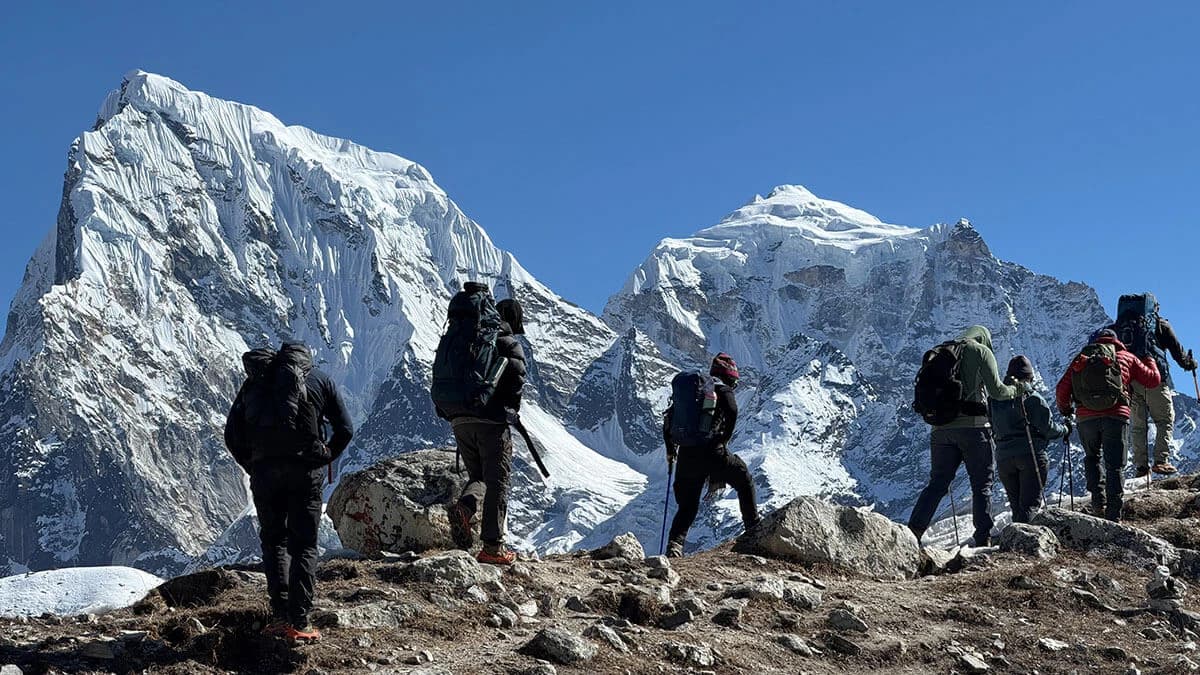
Why Trekking and Climbing Peaks in December Mid-Winter?
From my personal observation over the past seven to eight years, December has consistently offered clear blue skies, although the nights are extremely cold. As the trekking days began, I was slightly concerned, as the weather in the mountains is always unpredictable. Our plan involved trekking and staying above 5,000 meters for nearly a week, which made weather conditions a crucial factor.
Once in Lukla, we met our trekking crew, who were ready to carry the gear and handle the climbing logistics for the entire journey. We had tea and coffee before beginning what truly felt like the adventure of a lifetime; this time in mid-winter. On the day we flew into Lukla, only about 20 trekkers arrived, which was far fewer than the usual 400 per day during peak season. From the very first day, we were confident that the mountains would feel almost entirely ours. The only lingering question in my mind was whether December would deliver the same clear skies it had in previous years.
Trek Preparation from 10 days to 6 Months
This was my first high-altitude trek and climb since COVID-19 and nearly a decade since my last major expedition. Most of my recent time had been spent in the office managing logistics in Kathmandu. When I met the trekkers, they shared that they had prepared for more than six months, while I had managed only around ten days of preparation. During that short period, I focused on extensive walking between 15 and 25 kilometers each day, as time allowed. Naturally, I was nervous about whether I could keep up with the group's pace.
To ensure everything ran smoothly, we had a professional trekking and climbing guide, a Sherpa, and porters to manage logistics and support the group. Although I had not trekked for nearly a decade, I had participated in several Himalayan helicopter tours before and after COVID, landing at Lukla, Tengboche, and Gorakshep.
Adventure Begins with Blisters
We began hiking with me carrying a day pack weighing around 15 kilograms, filled with personal gear and snacks for the demanding days ahead, including the pass crossing and summit attempt. While preparing in Kathmandu, I had walked extensively in new hiking boots and developed blisters on my toes. However, with proper bandages and determination, I managed to overcome them once the trek began. By the time we reached Namche Bazaar, the blisters were no longer an issue, and I felt ready for the challenges ahead.
Wider and Safer Trekking Trails
To my surprise, the Khumbu Valley had changed significantly over the past decade. The trails were wider and safer, and the Hillary Suspension Bridge before the Namche uphill had been replaced with taller and longer bridges, shortening the walk by about ten minutes. Villages such as Phakding and Monjo now had more modern teahouses. Namche Bazaar, sitting at 3,440 meters, had expanded both vertically and horizontally and now offered bakeries, cafés, pubs, and branded gear shops. It remains a vital acclimatization point, and like most trekkers, we stayed for two nights.
Acclimatization Hike and Sagarmatha Next
On our acclimatization day, we hiked to the Everest View Hotel and enjoyed tea and coffee under clear skies, comfortably sitting in T-shirts despite the winter season. On our descent, we visited Sagarmatha Next, an organization doing remarkable work to reduce waste in the region by recycling non-biodegradable materials into usable products. It was heartening to meet volunteers who recognized Mountain Monarch as a company that regularly supports their mission. All our trekkers purchased small gifts from the center as a gesture of commitment to preserving the fragile Himalayan environment. I recall that one of our groups of 26 trekkers to the Everest Base Camp Trek had taken around 80 kilos of waste on their way back to Lukla. We also enjoyed a short yoga session led by one of our trekkers, a yoga teacher from Australia, with Ama Dablam and Everest as the backdrop.

Khumjung still holds its Traditional value.
The following day, our fourth day on the trail, we trekked to Khumjung, one of the fertile valleys of the Everest region. Life there felt much the same as it had 10 to 20 years ago, with locals tending fields, harvesting potatoes, and preparing land for future crops. We visited Khumjung School and the monastery, which had been renovated into a two-story structure displaying historic photos and paintings. The monastery also houses the famed Yeti scalp, preserved since 1974. The Yeti scape inside the monastery tells the heroic story of a local farmer woman who fought the so-called Yeti and slew its head to save herself. The same slanted head of Yeti has been kept at the Khumjung. Khumjung’s sheltered location made it warmer than Namche, and the group enjoyed a relaxed evening, bonding over card games and shared stories. We have great weather: every day is sunny with blue skies, though it's cold at night, and the weather forecast is great too, so I'm really getting excited to go higher. Everyone is walking in a very good place. My short trek preparation is really helpful for me to walk all these Himalayan flats and ups and downs
Climbing up to the Gokyo Lakes in Winter
As we trekked toward Dole and Machhermo, we encountered frozen springs along shaded sections of the trail. The view of Ama Dablam from Mong La was mesmerizing. Above 4,000 meters, tall rhododendron and pine forests gradually gave way to alpine shrubs. On the seventh day, we reached the stunning Gokyo Lakes, surrounded by snow-capped peaks and pristine waters. Traditional Himalayan settlements are changing into clusters of commercial teahouses. On the seventh day of our trek, we reached the Gokyo Lakes, a wonderland of a few teahouses just next to the pristine lakes, amidst a parade of snow-capped peaks. This is a most fascinating place missed by so many of the trekkers, as most of the traditional trekkers simply go to the Everest base camp via Thangboche and Dingboche, which is a shortcut and direct route to EBC. We plan to visit these places only on our return leg. We are making a big Everest Circuit Trek via Gokyo and Chola pass to EBC and Kalapathar. We can see teahouses throughout the Khumbu valley, with flush toilets and a cozy dining hall heated by wood and yak dung. We have clearly seen a shortage of yak dung this season due to the heavy snowfall in mid-October, which is still covering the terraces. Most of the mountain peaks are snow-covered, and it is fascinating to see the Khumbila peak just above Namche with snow on it, which is one of the rare sights.
Panoramic view of Gokyo Ri stuns All
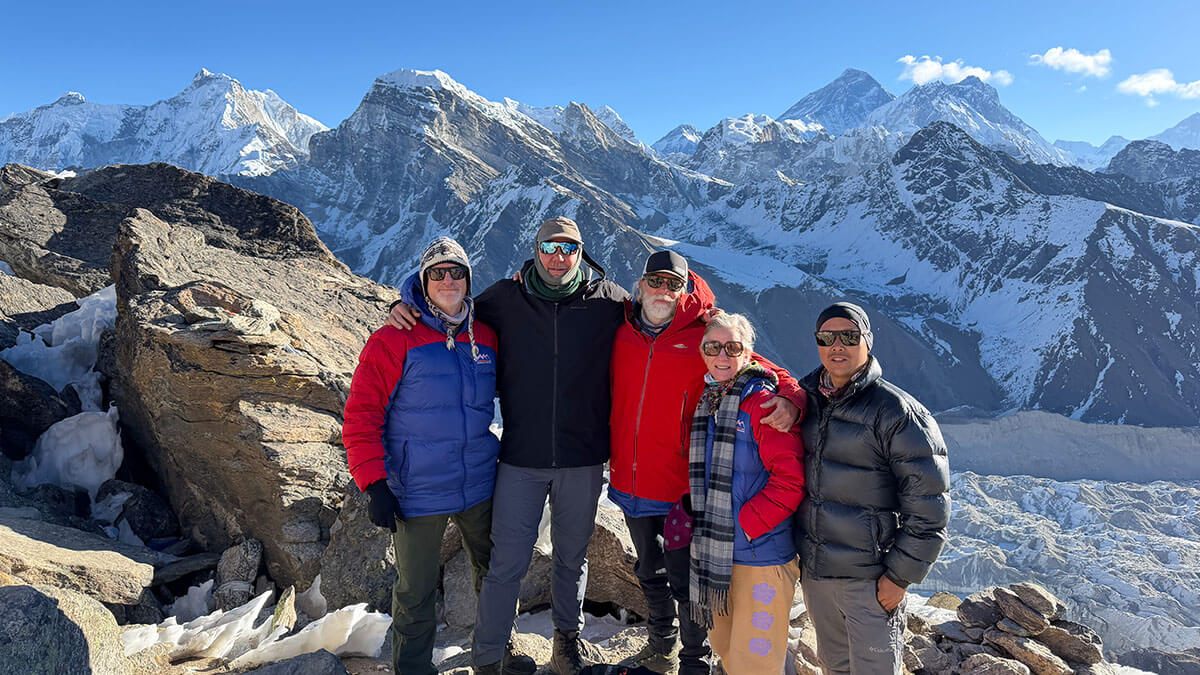
On day eight, we began our ascent of Gokyo Ri at around 4 a.m., reaching the summit after approximately three hours. The panoramic view of Everest, Lhotse, Nuptse, Cho Oyu, Cholatse, and the vast Ngozumpa Glacier was unforgettable. For most of the group, this marked their first time above 5,000 meters. While my original plan was to avoid Diamox, high altitude pills, as we have a supplementary oxygen cylinder with us as a safety backup. By the time we get to Gokyo close to 5000 meters, three trekkers opted to use it due to difficulty sleeping, while the others acclimatized well without it.
Crossing the Ngozumpa Glacier and Chola Pass in December
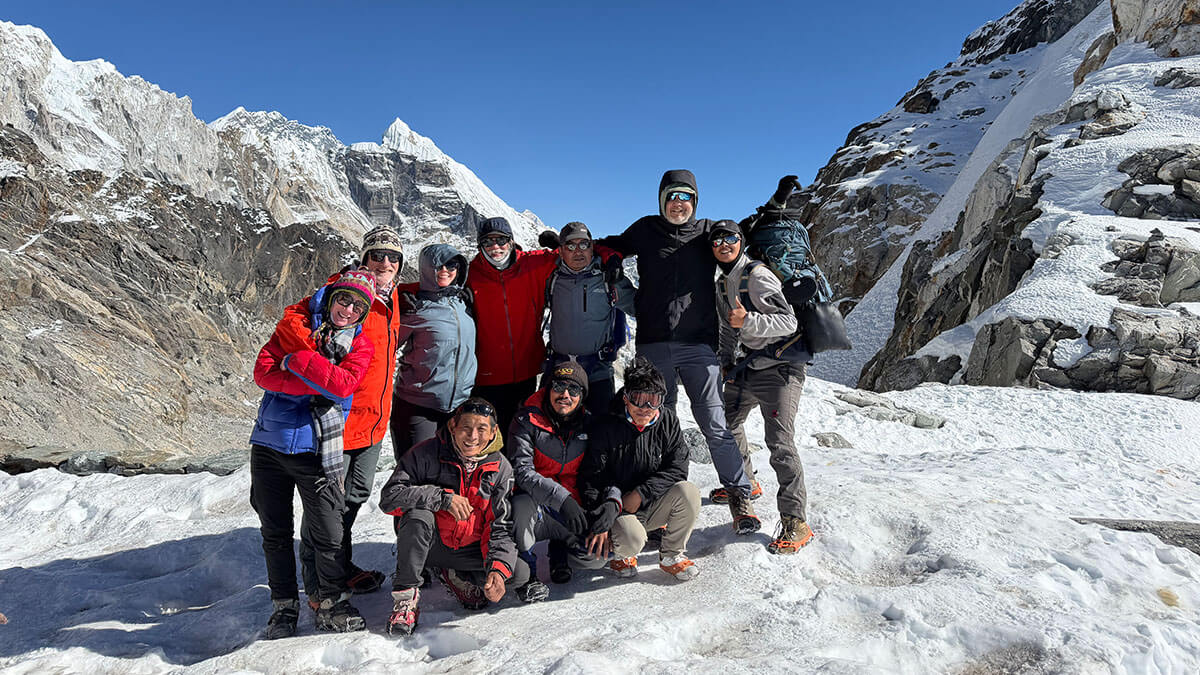
Crossing the Ngozumpa Glacier took longer than expected due to route changes caused by new glacial lakes. The following day, we tackled the challenging Cho La Pass. With microspikes and fixed safety ropes installed along the route, the crossing was demanding but safe. Standing at 5,420 meters, the group shared emotional moments of achievement. Though the climb with a day pack is tough, we have our strong porters who helped to reach the top without much pain. Standing at the top of Gokyo Ri and Chola pass, I can see the tears of happiness in my trekker's eyes, which is a relief to me that we have overcome and reached 5420 meters at the challenging Chola pass. We spend around 20 minutes taking photos and savoring the majestic view all around. Then my mission is to take them over 6000 meters to the top of Island Peak in a few days' time. So far, all the trekkers are well acclimatized, but they have started to feel drained physically, as it has been more than 10 days of continuous walking.
The Landmark Destination of Base Camp and the Sunning Sunset view from Kalapathar
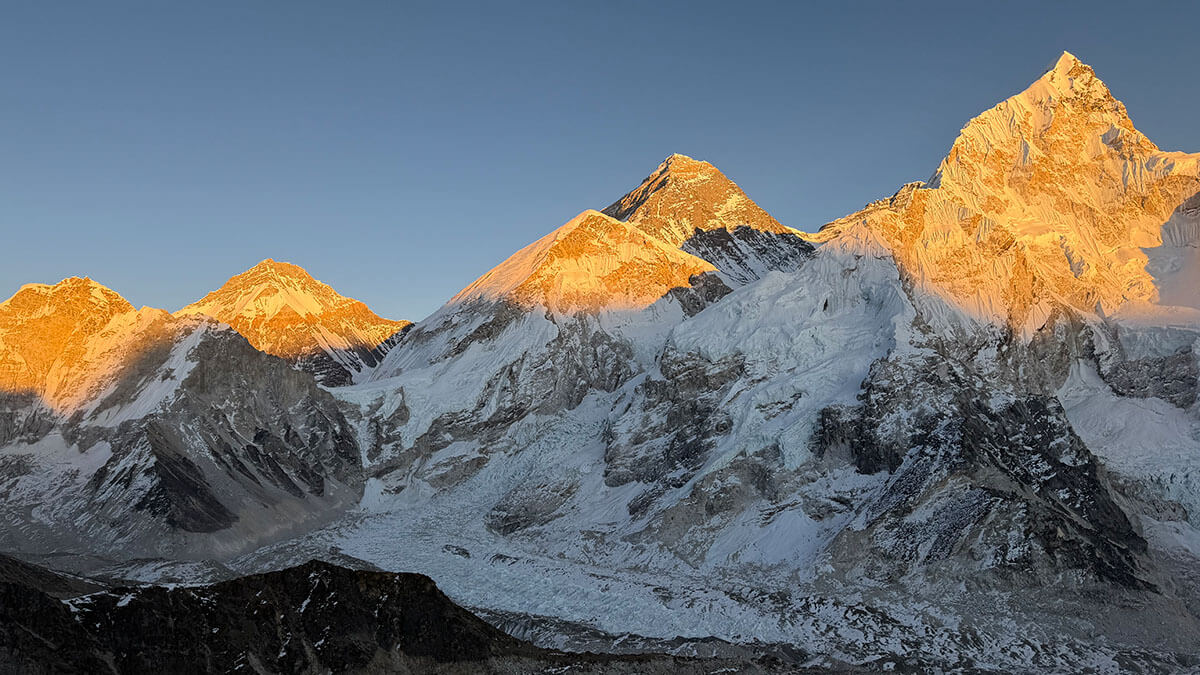
The group hike to Everest Base Camp, a destination for trekkers around the world. They also get closer to Kalapathar to catch the sunset view of Everest that evening, which is simply the best. As I have been to Everest Base Camp many times before, I climbed Kalapathar, stayed until sunset, and took some great night photos on my way down to Gorakshep. Nights are cold, around – 10 degrees, but we are happy to have the whole teahouse belong to us, where they used to accommodate around 150 trekkers every night in a single teahouse, and there are around 5/6 teahouses of this kind at Gorek Shep. We have a good sleeping bag and down jacket, and the teahouse has yak dung to warm the dining hall during dinner. We spend hours chatting and playing cards like at home, just a few of us in most of the teahouses, which is one of the best moments and advantages of trekking in December winter into the heart of the Himalayas.
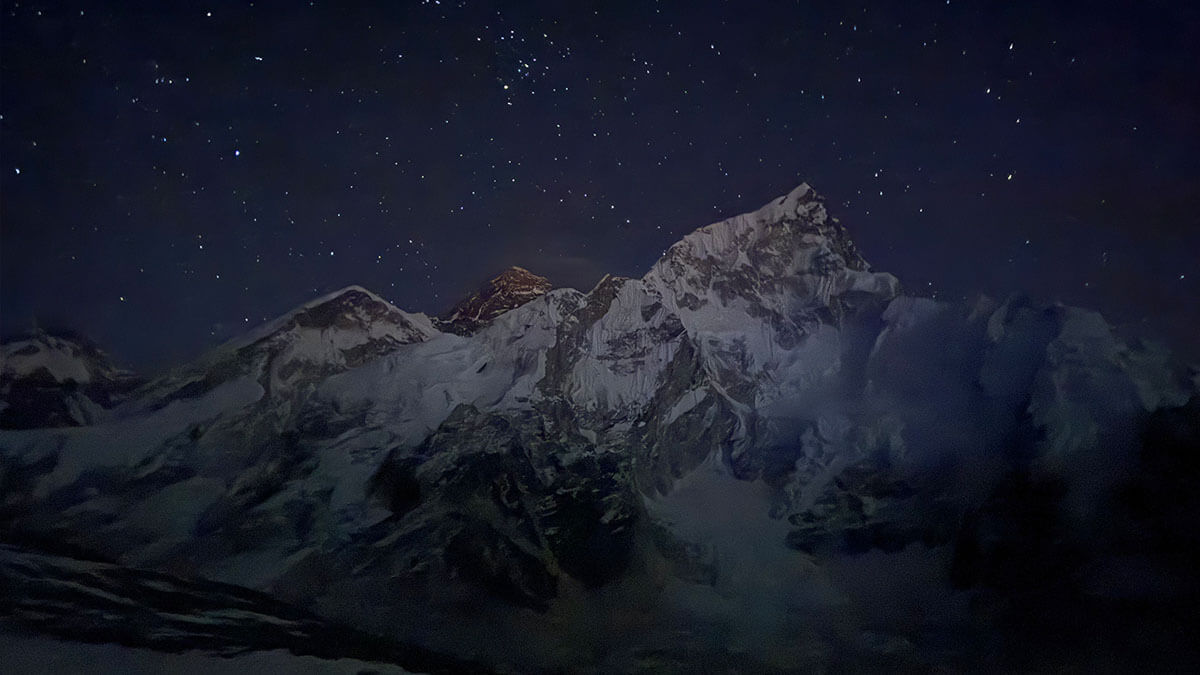
Heading to the Dingboche village
The next day we descend to Dingboche at 4360 meters, where we celebrate Christmas Eve, a great and unique moment to celebrate Christmas in the shadow of Everest and amidst the Himalayan peaks. The next day, three trekkers who are simply doing the Everest circuit trek descend to Lukla with our assistant guide and porter; they still have more to explore like Pangboche and Thangboche en route, as they are making a big circular trek around the Everest region. With two other climbers and a climbing guide, we began our journey into the thin air of the snow-covered Island Peak region, aiming to summit it on 27 Dec 2025.
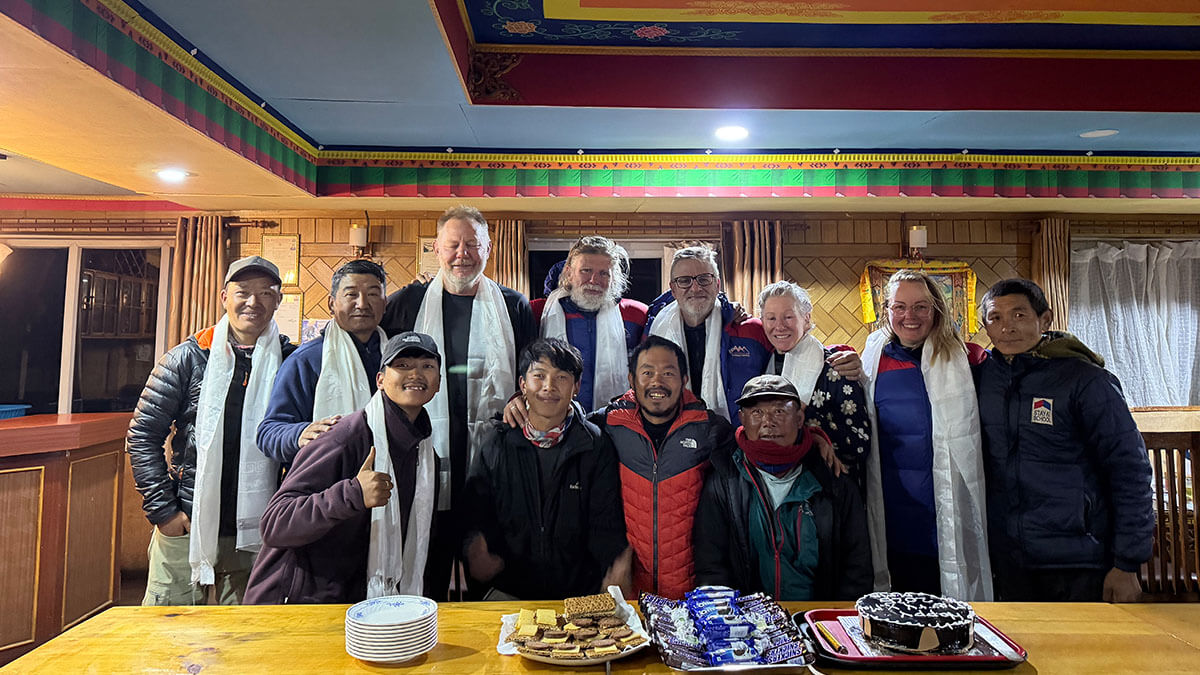
Climbing into the Thin Air in Winter
We got the tented camping at the base camp of Island Peak at 5100 meters, took off the trekking boots and put on climbing boots, crampons, harness, and a jumper, all extra weight, but all of us were ready for the next day's challenge. Climbing training of ascending with a Jumar and descending with a figure of eight has boosted the confidence. A great and helpful training, even if one is not experienced or has not used any climbing gear before. The climbing guide set up the ropes on the sloppy section of snow next to the camp, a real and practical basic climbing training before the summit push. We have an early dinner before sunset, plan to wake at midnight, have some breakfast, and be on the trail by 1 am. The excitement and tented camping hardly allowed for any hours of sleep that night for most of the climbers.
Climbing Island Peak on 27 December 2025
Finally, the summit push started as planned at around 1 am. It was one of the coldest nights, probably – 10 degrees Celsius, while we started from the base camp. We all have all our climbing gear, proper warm gear, a packed lunch, enough drinking water, and energy bars for the whole day. It is an anticipated long day of 1100 meters up and down. We are prepared and ready to face the challenge and determined to conquer the Island Peak, locally known as Imjatse Peak. This peak is named Island Peak as its name suggests it stands out like an island on the sea surface of snow peaks all around it. It took around 2 hours to get to the high camp on this chill morning, and we are on normal time and pace. As we went higher, the wind started to get stronger but bearable, and probably the temperature dropped to -20 degrees Celsius for the sunrise. Before the sun rose, we reached the crampoon point, crossing some of the uphill sections with rocks and boulders. Thanks to having completed this uphill section with a head torch, we simply followed our experienced guide's footsteps step by step. Getting the crampoon points means you have done most of the uphill and difficult section, but from here the climbing section starts with ropes and jumers, and the mountain allure you. Once we all have a crampoon, harness, and jumper, we all have a safety rope to walk together. This season, due to the heavy snowfall in October, we don’t have crevasses or ladders to cross, and there are no rock-falling sections, so climbing Island Peak is relatively easier and safer.
Jumring up 300 meter Head wall of 60 degrees inclined
With the sunlight and relatively warmer, we started to climb the headwall, which is around 60 degrees inclined and around 250 meters to the top. It took us some time to trust the Jumer to pull ourselves up on this fixed climbing rope. At that moment, you are in the real drama of climbing the mountain in every step with the help of an experienced climbing guide next to you, and you are practicing what you have learn yesterday on climbing training. Once you get the simple rule of jumering up, you start to enjoy the climb then the climbing to the top becomes relatively easier. But if you don’t have confidence or trust in jumping up, it is better to get help and develop the skills and confidence there and then with guides, so your climb is safe and enjoyable. Jumaring is simple, and once you have rhythm, you start to enjoy it, and the climbing becomes relaxed and safer. We have some extra rope which our climbing guides have used at some of the difficult sections and on the way down to belay the climbers safely. The headwall climb is tough and tiring, requiring stronger hands and legs, as well as mental preparation. Despite high wind and some struggle on the rocky section of headwall climbing, we got to the top of Island Peak, 6189 meters above sea level, just before 10 am.
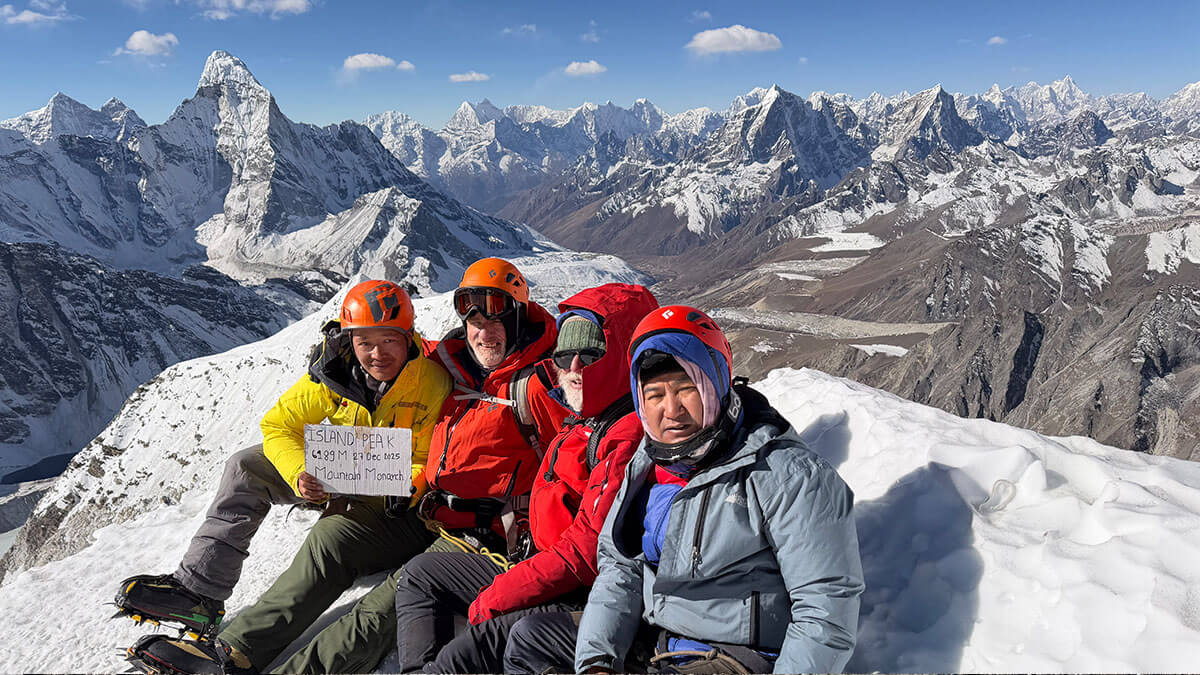
Sensational View and Feeling Standing on Top of Island Peak, 6189 meter
Once at the top, the view is simply sensational mountain all around like Nupse Lotse, Makalu, Baruntse, Mera, Amadablam, Cholatse, and the ever-growing Imja lakes. To my surprise, I witnessed how men in their 50s and 60s cry with happiness once they conquer the peak. Personally, I am very happy to stand on the top of Island Peak and thank my guides for their support and hard work. We thank God for such beautiful sunny days throughout December and a safe ascent. We spent around 30 minutes on top, which went like 5 minutes taking photos, video, and above all cherishing the moment of standing on top, an experience of a lifetime never to be forgotten.
Descend from Summit – Figure of Eight and Belay Rope Device
Till now at the summit, we are just halfway. We started our descent with the help of a figure of eight, and in some places with a belay rope technique. We got to the base camp sometime around 4 pm, and on descent we realized how much we had climbed before sunrise. Despite being low on energy by the time we reach base camp, we have warm soup, which motivates us to continue descending for 2:30 hours to Chukung. Once at Chukung, most of us have some soup before we go to bed, and we get a really good night's sleep like a log.
Island Peak base camp to Lukla – quick descent
It only took us 3 days to get back to Lukla and flew to Kathmandu on 31 Dec 2025, again a very smooth early morning flight to celebrate New Year's Eve and the New Year in Kathmandu, of course, a warmer and cozier place.
Take Away: Absolutely, A wise Decision of Trekking and Climbing in December
Thus, the year-end trek to Gokyo Chola EBC with Island Peak climbing is one of the most memorable and great adventure experiences of my lifetime. As the owner of Mountain Monarch, I sincerely encourage trekkers to seriously consider undertaking adventure trekking and climbing selected peaks in December. Winter trekking in the Himalayas offers one of the best times, so don’t miss it. We probably need to rethink the trekking and climbing season in the Himalayas, as weather patterns are changing. Looking forward to hiking and climbing together in December.