What You Must Pack for Trekking to Everest Base Camp and why?
What You Must Pack for Trekking to Everest Base Camp and why?
Updated on January 01, 2026
Taking you to the foot of the world’s tallest peak, the Everest Base Camp Trek is, no wonder, one of the most iconic trekking journeys in the world. Sherpa villages, Himalayan scenery, the diverse landscape of the Sagaramatha National Park, and, as you climb the final trail to Everest Base Camp, the stunning Khumbu Glaciers, make it a dream place for everyone who dreams of adventure. Considered beginner-friendly, the right gears are non-negotiable.
The Everest Base Camp trekking route includes hiking through the UNESCO World Heritage Site listed Sagarmatha National Park, and its varying trails, densely forested, steeply uphill climbs, and descents, and at certain points, rugged terrain as well. The changing weather additionally adds much to the challenges, making it important that you have the correct equipment and gear for the Everest Base Camp trekking.
Why do Gear for Everest Base Camp Trek matter?
Regardless of the season, you are trekking to Everest Base Camp, whether it's spring or autumn, considered peak time for high-altitude treks and climbs, including the Annapurna Base Camp Trek, the Manaslu Circuit Trek, the Langtang Trek, or other trekking and climbing routes in Everest itself; it can get extremely cold in the mornings and nights. At high altitude, afternoons can be windy, and snowfall is common.
The access to supplies is limited; therefore, it is a must that you pack appropriate trekking gear and equipment for Everest Base Camp hiking beforehand so you do not suffer from discomfort, frostbite, or fatigue. When you have the right equipment needed for the Everest Base Camp Trek, it also increases the mobility and success rate of the Himalayan trip. You stay warm in comfort even at such an altitude and remoteness.
Dressing in three layers for trekking to Everest Base Camp
As mentioned earlier, the weather in the Himalayas is known for its noticeably unpredictable nature. In a second, it can go cloudy and windy from sunny to rainy and snowy. Three layers of clothing ensure that you stay prepared for changing Himalayan weather on the way to Everest Base Camp. Include moisture-soaking base layers, an insulated mid-layer, and the outer layer capable of protecting you from rain and strong wind. Consider packing:
Base layer: Include merino wool or synthetic long-sleeved thermal tops, leggings, T-shirts, pants, breathable underwear, and 2 pairs of sports bras for women. Make sure these sit directly against your skin and are quickly drying. With this on your Everest Base Camp trek gear list, you get to maintain your core temperature.
Mid-layer: A high-quality fleece or down jacket as a mid-layer is a must to not miss adding to the Everest Base Camp Trek Equipment List. As altitude increases, the temperature drops significantly, and an insulated mid-layer helps to trap the heat in your body and protect you from freezing conditions.
Outer layer: Wind, snow, and occasional precipitation are common natural phenomena in the higher Himalayas. So a good shell layer to shield you from harsh weather is another essential piece of equipment for the Everest Base Camp Trek. Do pack a waterproof and windproof jacket and pants (Gore-Tex or similar).
New trekking boots, other footwear, and handwear
For multi-day high-altitude treks and climbs in Nepal, including the Everest Base Camp Hiking, instead of new trekking boots, the guided Everest Base Camp Trek equipment recommends well-broken-in ones so you do not have to deal with blisters. It should be ankle-supporting, lightweight, and fit you perfectly so even on uneven trails, rocky terrain, and long descents, you do not lose your balance.
Besides it, several pairs of wool or thermal socks, liner socks, and slippers for comfort while staying in the teahouse are other must-haves on the gear list for the Everest Base Camp trek. Likewise, you would not like frostbite to affect your hands due to significant heat loss from your hands. So, pack waterproof outer gloves or insulated gloves; you will breathe in relief, especially on the way to climb Kala Patthar and Everest Base Camp (EBC).
How should your backpack and bags be?
Two of the must-haves on the Everest Base Camp trek gear list are the daypack to carry personal and daily essentials, and the duffel bag, which is often carried by porters on guided Everest Base Camp treks. You may choose to carry both yourself; however, with increased altitude, even the lighter daypack can feel heavier, making it wiser to take help from local porters so you save both energy and time.
20-30 liter daypack to carry day-to-day essentials like a camera, snacks, a jacket, toiletries, a power bank, a brush, toothpaste, and first aid kits, including personal medications if taking any. The duffel bag is to carry other necessary equipment needed for the Everest Base Camp trek. Make sure they are with rain covers for better protection of your belongings: a daypack, a torso-fitting, and a durable duffel bag for main luggage.
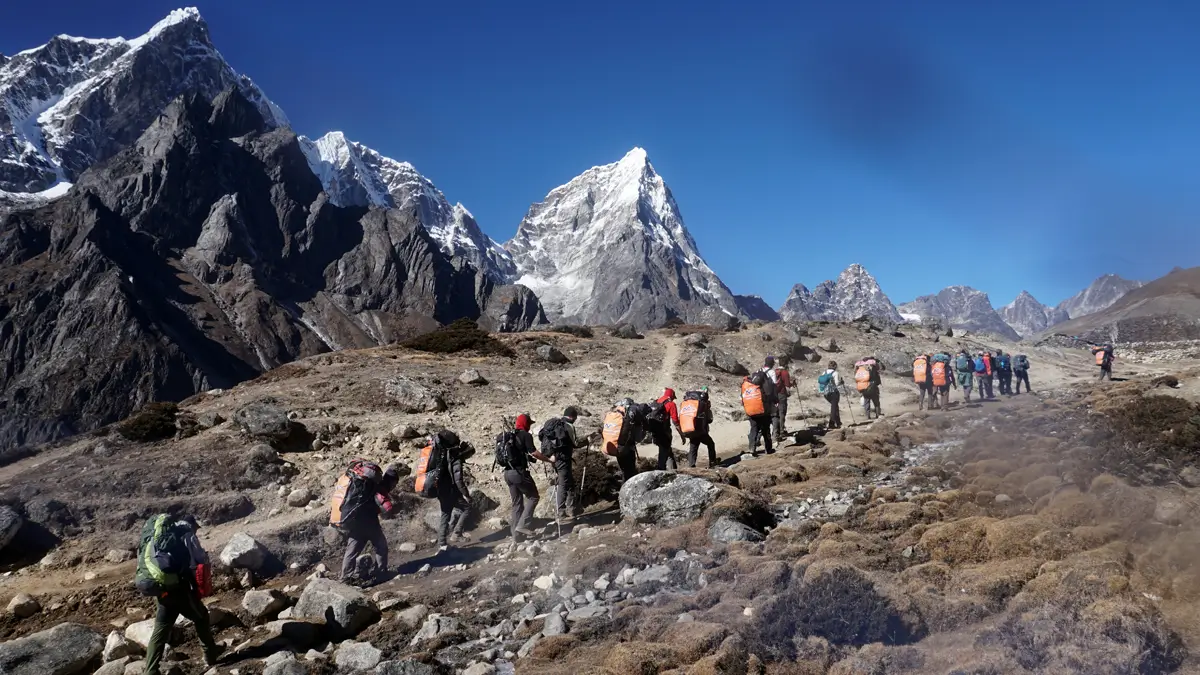
A team of trekkers with our local porters carrying trekking gear and equipment for the hike to Everest Base Camp (EBC)
Must you have technical gear for trekking to Everest Base Camp?
In comparison to some other Everest Himalayan treks and climbs, such as the Everest Three Passes Trek, the Everest Circuit Trek, and Island Peak Climbing, the Everest Base Camp Trek is non-technical, so, in general, you do not need technical gear and equipment for hiking to Everest Base Camp. But if planning to extend the trip or choosing challenging journeys like the Everest High Passes and Peaks Trek, it is good to keep some handy.
Everest Base Camp trekking map, lightweight crampons, microspikes, carabiner, multi-tool knife, sleeping bag, thermal blanket, altimeter watch to track your heart rate and elevation gain, oxygen cylinders, and dry bags to cover electronics and other essential paperwork like government permits. You may not need heavy gear and equipment unless and until you are on a combined Mera and Island Peak Climbing or the Baruntse Expedition at 7,000 m above.
What are the Everest Base Camp trekking accessories to not forget?
Trekking accessories are small but practical things. In the packing lists for the Everest Base Camp trekking, do not forget to include a headlamp with spare batteries for the days with early morning starts. UV-protected sunglasses, sunscreen cream, a sun hat, a warm beanie, reusable water bottles, and a high-voltage power bank. Buff, neck gaiter, lightweight and quickly drying towel, and adequate Nepalese cash from the city are highly recommended.
Although these are minor, you would not want to make the mistake of avoiding packing them. In harsh mountainous environments, these keep you protected and prepared for all kinds of unforeseen circumstances. In case you enter the rugged and more remote areas where electricity is scarce, a power bank means you can charge your phone and connect with concerned authorities. Likewise, a refillable water bottle ensures you stay hydrated.
Things your first kits must have
While the Everest trekking region now has more improved services than other, more remote and off-the-beaten regions like Langtang, Manaslu, and Dolpo, it has yet to do better in health facilities like those in city areas. In case of a medical emergency, helicopter evacuation to Kathmandu or Pokhara is the only option for better healthcare. For immediate relief and to minimize the risks, a first aid kit is another must to pack for the Everest Base Camp Trek.
Make sure it has basic medications, treatment for blisters, pain relievers, and altitude medications like Dimox. If you are wondering what to pack, consider Brufen, ibuprofen, antibiotics, paracetamol, handy plasters, bandages, tincture of iodine, Ondem, cetirizine, and electrolytes. At Mountain Monarch, we do not compromise with your health and safety; 1 porter per trekker and oxygen and first aid kits on standby make the best out of the journey.
Where can you buy equipment for the Everest Base Camp trek?
In case you forget to carry the equipment needed for the Everest Base Camp trek or miss out on important gear from the Everest Base Camp Trek Tour Packing List, no need to worry; the vibrant town of Thamel has your back while in the Kathmandu Valley, and in Pokhara, Fewa Lakeside, you can find all of these. From shoes to gaiters, crampons, and climbing ropes, choose the ones that suit you the best.
Budget-friendly, standard, or expansive ones, the touristic town of Thamel offers you a wide variety of trekking and climbing gear. Feel free to haggle respectfully; some might even enjoy the process, but if you are someone short on time and find it a hassle to bargain, it is good to choose a service from a trustworthy trekking and climbing agency offering packages that are all-inclusive, including essential gear and equipment for trekking to Everest.
The Best Everest Base Camp Trek Gear Tips for Beginners
While you may hire porters to carry your gear and equipment for trekking to Everest Base Camp, there is a limitation on how much they can carry at once, so they are not overworked and underpaid. Therefore, pack only those necessary. If you are first-timers and do not want to spend a heck of a lot on trekking gear and equipment for Everest Base Camp, you may choose to rent. Leave those that might not be useful back in Kathmandu.
Or consider taking a comprehensive Everest Base Camp Trekking package from licensed and experienced operators such as Mountain Monarch. We provide essential solo and group trekking and climbing gears not only for trekking to Everest Base Camp but also for Mera Peak Climbing, Island Peak Climbing, Lobuche East Peak Climbing, and the Mount Everest Expedition to conquer the top of the world. Bookings are now open.
Conclusion
The right trekking gear and equipment for Everest Base Camp is not about luxury or carrying everything you own. It is about safety, comfort, and essentials that boost your confidence and performance in the physically and mentally demanding arduous Himalayan setting, where everyday amenities that you enjoy in the city are almost nonexistent; a perfect escape to nature and mountains away from crowds and internet life.
For one of the greatest trekking destinations on earth, the guided Everest Base Camp packing list is to make sure the gear and equipment in the Everest Base Camp tour packing list are capable of providing you peace of mind. It allows you to focus on the experience without adding loads to your back. So pack light, pack smart, and pack right for Himalayan trekking, be it to Everest or Langtang. For more up-to-date information, contact us now.
FAQs
Why do you need to pack extra layers for trekking to Everest Base Camp?
During winter, temperatures in the Upper Himalayas of Nepal can drop below the freezing point. Trails are often covered in dense snow; therefore, to stay warm, packing like that for trekking in spring and autumn may not be enough. Including for the Everest Base Camp Trek (EBC), extra sleeping bags, blankets, and thick clothing become essential.
Can you directly drink from rivers, streams, and taps?
While water from natural sources along the Everest Base Camp trekking route may look clear and clean, it can be contaminated. Therefore, drinking without purification is not recommended, and the safest option is lukewarm boiled water refillable in teahouses along the hiking trail.
Is it good to carry snacks from Kathmandu or buy them in Lukla?
Snacks are for a quick energy gain; hence, they are always good to include in the packing list for a Himalayan trip to Everest Base Camp, and yes, you can choose to purchase them once landing in Lukla, but it often tends to be costlier than in the main city areas, so it is wiser to carry them right from Kathmandu.
How are hot showers in the Upper Himalayas?
First of all, cold showers can make you catch chills; therefore, only hot showers are recommended, which also often means a bucketful of lukewarm water and a jug at some additional cost. Hence, wet wipes are called the Himalayan shower at and above 5,000 m, allowing you to maintain hygiene without exposing yourself to cold.
Why do you change your money into Nepalese rupees in the city?
As you leave the city area behind, ATMs are rare. Even if available at a larger and more popular village like Namche Bazaar, it is not reliable; therefore, even before the trip departure day, visit Thamel and exchange into Nepalese rupees for personal spending, while the package cost from Mountain Monarch covers managing all the essentials.