Must you hire a guide for trekking to Everest Base Camp? Here’s why
Must you hire a guide for trekking to Everest Base Camp? Here’s why
Updated on January 12, 2026
The Everest Base Camp Trek takes you to the foot of the world’s tallest mountain, Sagarmatha/Mount Everest (8,848.86 m); no wonder it is a dream trekking destination for thousands of trekkers and climbers. Through the heart of the legendary Khumbu Valley, walked by legends like Sir Edmund Hillary and Tenzing Norgay Sherpa to scale majestic Mount Everest itself, also known as Chomolungma in Tibet, an unforgettable journey awaits.
Although the Mount Everest Expedition may not be accessible for everyone, the Everest Base Camp Trek is doable even by first-timers if done with professional support, so this blog highlights whether you must hire a guide for trekking to Everest Base Camp or not. This guide to the Everest Base Camp Trek for a better approach also compares the guided Everest Base Camp Trek and the Everest Base Camp Trek without a guide.
Understanding the Everest Base Camp Trekking Trail
16 days for the Everest Base Camp Trekking Itinerary is the standard one that we are offering at Mountain Monarch. An extra spare day at Namche Bazaar and Dingboche is so that your body gets enough time to acclimatize to the high altitude. In the meantime, you also get to make the best out of the Himalayan trip, hence it is called the best route, including for the years 2026 and 2027, specifically for beginners.
This Everest Base Camp Trek itinerary allows you to maintain your pace and relish the mountain views of Everest, Lhotse, Nuptse, and Ama Dablam without rushing. Sherpa villages, monasteries, Gompas, and mani walls decorated by prayer flags—authentic cultural experiences are there, as are chances of wildlife encounters inside the Sagarmatha National Park and more open and magical views from Kala Pathar during sunrise.
Navigating the Everest Landscape Legally: Is a Guide Mandatory?
Although the Everest trekking and climbing region has remained a paradise for free individual trekkers (FITs) for years to roam and explore the area freely, since April 1st, 2023, solo trekking and climbing without a guide has been highly restricted. I.e., yes, now, to legally access it, due to safety concerns, most of the local trekking agencies in Nepal, including Mountain Monarch, insist that you do trekking to Everest Base Camp with a guide.
Despite the local Khumbu Pasanga Lhamu Rural Municipality occasionally trying to maintain its own autonomy, creating a loophole, when you are with a licensed Everest Base Camp Trek Guide, the success rate of the journey increases. Cultural immersion gets easier; a trained guide shares safety tips so you can tackle potential challenges. For an enhanced experience, hiring a guide is non-negotiable.
Why is the Everest Base Camp Hike Sherpa Guide highly recommended?
Those from the Sherpa clan are celebrated in the world for their superhuman-like adaptability skills to arduous mountain surroundings. Several Sherpas holding world records in mountaineering were born and brought up in the Himalayas; therefore, you are in reliable hands that can actually make it happen to conquer your dream destination. How and why Everest Base Camp hiking Sherpa guides are strongly advisable: here’s the brief:
Navigation and Trail Knowledge: Insider Insight Does Matter
While most of the Everest trekking routes are well established, like the Everest Three High Passes Trek, the Gokyo Lakes Trek, and the Everest Circuit Trek, besides the Everest Base Camp Trek Trail, as a new path for you, you may not be completely aware of the unforeseen circumstances, which actually are common in the higher Himalayas. Unpredictable weather and landslide-prone areas: A guide for trekking to Everest Base Camp keeps you informed.
Trekking to Everest Base Camp with a guide helps you stay on the right route at all times. Even during sudden fog, snow, or storms, locals to the Himalayas who know the place you are trekking to from inside and out make sure that you stick to the Everest Base Camp Trekking itinerary, avoiding closed or more challenging trail sections. This local expertise is especially valuable during times of the year considered off-season for trekking: summer and winter.
High altitude and safety: Prevention of a silent threat
In the Khumbu Himalayas, the real challenge is not the diverse landscape, landslides, or even Yeti; it’s the air. At 3,000 m above sea level, the presence of oxygen in the air drops significantly, to around 50% less than at sea level, and in the lack of proper acclimatization, anyone, regardless of their age, fitness, and experience level, can suffer from altitude sickness or acute mountain sickness (AMS).
At these times, the Guide for Trekking to Everest Base Camp, who is well trained to lead high-altitude treks, climbs, and expeditions, helps to spot the early signs and does not let it get severe into fatal conditions like HACE and HAPE. A professional guide to the Everest Base Camp Trek checks your daily oxygen saturation, monitors your heart rate, and provides exact guidance on when to stop or continue or contact authorities in an emergency.
The cultural and linguistic bridge: Beyond Pathfinder
Yes, you may follow the Everest Base Camp Trekking Map and reach Base Camp, but without an Everest Base Camp Hike Sherpa Guide, you would miss the “soul” of the iconic Khumbu Valley of Nepal, the heartland of Sherpas. They explain to you the significance of Mani walls, prayer wheels, gompas, prayer flags, and monasteries like Tengboche (the largest Buddhist monastery in the Everest region).
Might even introduce you to the best-kept secrets if you request. They share dos and don’ts, so building a local connection without hurting the cultural sentiments with the Everest Base Camp Trek Guide is seamless. Being locals themselves, their connections are often helpful to manage accommodation and meal options of your liking, even during the peak trekking and climbing seasons of spring and autumn.
Sharing the burden of logistical management
Independent Everest Base Camp trekking does not mean complete freedom only; it also means managing essential logisticsin unfamiliar conditions by yourself. From permits, meals, and lodging to mountain flights to Lukla, it can be a hassle for anyone. Answering the question, "Do you need a guide for the Everest Base Camp Trek?" to enjoy the awe-inspiring scenery and save energy and time, a guide for trekking to Everest Base Camp is a wiser decision.
On booking the Guided Everest Base Camp Trek package as such offered by Mountain Monarch, led by the professional mountain guide himself, Pradip Limbu, with more than two decades of experience, we take care of all the essential logistics. Everest Base Trek permits, teahouse, meals, and day-to-day plan: Trekking to Everest Base Camp with a guide provides the right ambiance for you to fully engage in making memories rather than logistics.
Everest Base Camp Trek Cost vs. Value in 2026 and 2027
There is zero argument that hiring a guide can add to the Everest Base Camp trekking cost, but is it worth it? Yes, it is. Mountain Monarch, in addition, follows the 1 porter per trekker policy, also carrying an oxygen cylinder on standby for immediate assistance if needed. Your safety, satisfaction, and success are what matter to us the most. If you are planning a unique way to conquer Everest Base Camp, we do our best to make it happen for you.
Join our fixed departures in spring and autumn of 2026 and 2027, or opt for a solo, private, or family Everest Himalayan trip with an Everest Base Camp Trek private guide; we stand second to none in making all the essential arrangements for you at a reasonable cost. Premium services, wherever available, including the provision of essential gear and equipment for trekking to Everest Base Camp. Reserve your spot now.
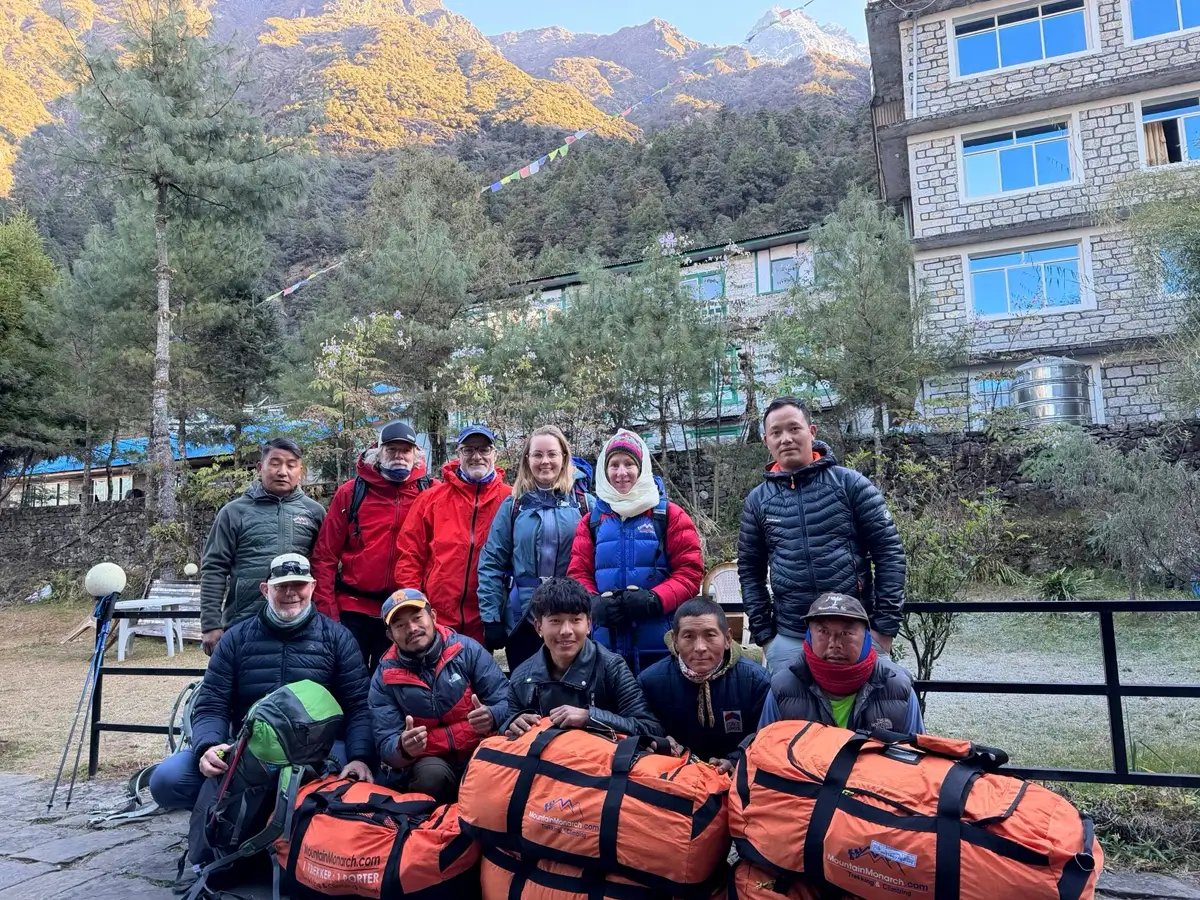
A team of trekkers and climbers with a well-experienced mountain guide and porters from Mountain Monarch at Namche, Everest.
Guide vs. Porter vs. Sherpa Guide vs. Private Guide: Core Differences
Licensed Everest Base Camp Trek guides lead the trekking trails, navigate the terrain, and manage the logistics, but they will not be carrying trekkers' backpacks. Porters are the ones who lift your luggage, who also make sure they are not overworked and underpaid is legally allowed to carry only 25kg shared between two trekkers. Meanwhile, Sherpa guides are also registered but are often highly experienced and come with a mountaineering background.
If you are more in favor of a personalized journey, that is when you hire an Everest Base Camp Trek private guide. With a private guide, you have more flexibility without having to match the pace of a group. You may choose to spend extra days at the villages you find most attractive. Attention and support are also one-on-one and are excellent options for photographers, families, and aged trekkers who may have other goals and pace to normal.
What kind of trekkers are best suited to hire a guide?
As by now you must be clear that hiring a guide for trekking in Nepal is legally mandatory, and even if it was not, if you are a first-time trekker in Nepal, new to high-altitude trekking and climbing conditions, or planning to do a solo trek, especially in winter or monsoon seasons, you will not regret hiring a guide to Everest Base Camp Trek. For a cultural and educational experience, local guides are always to be thankful for.
In this way, you also get to contribute to responsible tourism both directly and indirectly as well. Besides agriculture and animal husbandry, tourism is one of the major sources of income in the remote Himalayas of Nepal, so by choosing a guide for trekking to Everest Base Camp, you also become a part of increasing employment in mountain communities, the people who make it possible for you to access the sky-towering hills and mountains.
Can you do the Everest Base Camp Trek without a guide?
You can do day tours and treks such as Shivapuri Hike, Nagarkot Hike, and Sarangkot Hike in and around the major cities of Nepal: Kathmandu and Pokhara. However, beyond that, into the Himalayan region, it is a must that you are accompanied by a professional guide from government-registered trekking, climbing, or tour operators like Mountain Monarch. Seasoned trekkers who may prefer trails to themselves may choose not to join the group.
However, trekking to Everest Base Camp with a guide, even if you are physically fit and have prepared yourself for it, is what we strongly recommend. Serene experience is there at your own pace, so is the enhanced safety, as Everest Base Camp Trekking without a guide comes with increased risks of difficulty in managing altitude-related issues and logistics like the Lukla flight, and there is no one to rely on during potential illness or injury.
Conclusion: Guided Everest Base Camp Trek vs Everest Base Camp Trek without a Guide
So the conclusion to the question of whether you must hire a guide for trekking to Everest Base Camp is yes; while the physical trail is well-trodden, the hidden challenges of altitude, logistics, and differences in culture and language make a guided Everest Base Camp trek a wise investment. Trekkers and climbers should never underestimate what the Himalayas are capable of doing in the blink of an eye, especially when they choose not favor you.
Everest Base Camp Trek without a guide means there is no one to provide you with aid even in an emergency, boost your confidence, and take care of your comfort. In contrast, is the experience you get from hiring an Everest Base Camp trek private guide. A private guide means unmatched safety, cultural depth, and logistical ease, and we do provide that at Mountain Monarch. Contact us now. Purchase an entire package or book guide before others do.