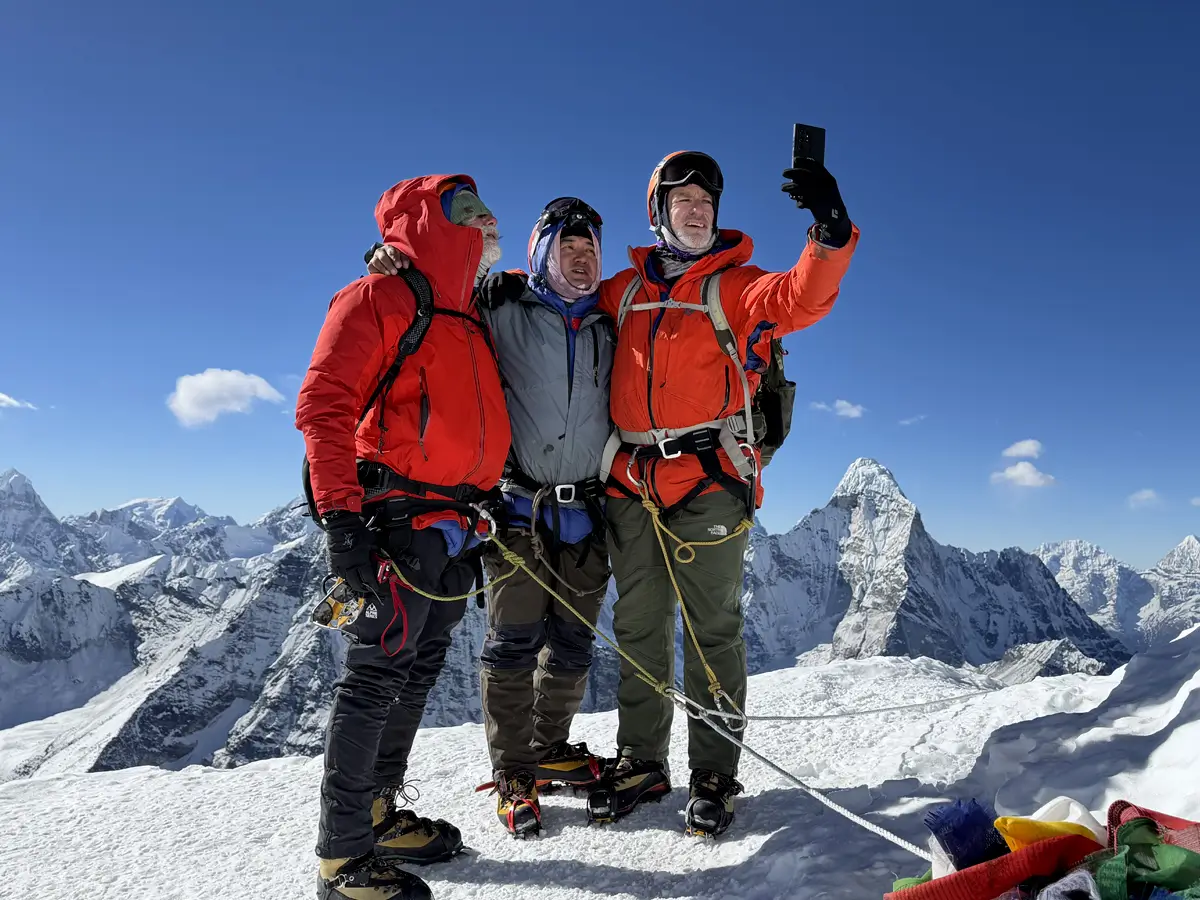
Main highlights include high-altitude trekking, basic climbing skills, stunning mountain scenery, and the Sherpa culture. Here's the best Island Peak climbing itinerary for beginners if you are planning Island Peak expeditions in 2026 and 2027. This guide is to ensure you have a hassle-free experience, a higher success rate, reach the top of Island Peak, and retrace the route back.
Where is Island Peak?
Amidst the massive snow-capped peaks of Everest, Lhotse, and Ama Dablam, Island Peak is in the northeastern part of Nepal within the Sagarmatha National Park, which is one of the UNESCO World Heritage Sites in the country. The peak lies near the isolated village of Chhukung and was named so for its island-like appearance emerging from ice above the beautiful Imja Khola Valley, often covered in snow.
The best Island Peak climb route allows a gradual transition from hiking to mountaineering, where the trek to Everest Base Camp at first allows a proper adaptation to the mountainous surroundings with thinner air. As you follow the classic Everest Base Camp Trekking route as the Island Peak Trekking trail, the journey is well supported by comfortable teahouses, lodges, and guest houses.
Key reasons to choose Island Peak
Unlike the Baruntse Expedition, the Everest Expedition, and the Manaslu Expedition, Island Peak does not have extreme technical demands. The climbing is relatively straightforward, and as you journey through the Everest Base Camp at an elevation of 5,364 m above sea level, also the closest you can get to the tallest mountain in the world, Mount Everest (8,848.86 m), without summiting the peak itself, you have ample time for acclimatization.
Up to Chukkung, also called the Island Peak Base Camp, you can find well-established teahouses, lodges, and guest houses to take care of your daily essentials like meals and lodging, as well as modern amenities such as Wi-Fi, hot showers, and electricity to charge your electronic devices. The difficulty level is moderate and manageable for physically fit individuals, making it an ideal option for beginner Himalayan peak climbing.
How long does it take to complete the Island Peak Expedition Itinerary?
The standard Island Peak trekking and climbing itinerary typically spans 20 days, starting with a flight from Kathmandu to Lukla, followed by acclimatization days in Namche Bazaar, and then continuing to Everest Base Camp, Kala Patthar, and finally Island Peak Base Camp, which includes an additional exploration day. It is handpicked by professional mountain guides from Mountain Monarch.
In addition, we are happy to customize it for a more personalized experience. With more adventurous options like Mera and Island Peak Climbing, which is a 26-day round trip, in general, the distance you cover is approximately 120–140 km/75–87 miles if you stick to the classic one. Well-experienced trekkers and climbers may choose to skip some acclimatization days, but for beginners, it is rather wiser to add them.
A team from Mountain Monarch made it to Island Peak in style on Dec 27, 2025!
Day by Day Island Peak Trekking and Climbing Itinerary
Day 1 - Day 2: Arrive in Kathmandu and Trip Preparation
On your arrival at the Tribhuvan International Airport (TIA), one of the team members from Mountain Monarch picks you up and transfers you to your hotel. You may choose to rest to get over jet lag, explore the city, and on the next day, check your gear as part of the preparation.
Day 3 - Day 5: Fly to Lukla, Trek to Namche, and Acclimatization
The journey to climb the Island Peak officially begins on the 3rd day with a mountain flight to Lukla from Kathmandu. To spend the night, you hike up to Phakding, and on the 4th day, you make it to Namche Bazaar, where you will spend yet another day for proper acclimatization.
Day 6 - Day 8: Trek to Dingboche via Photse and Monla, and Acclimatization Day
As you leave Namche Bazaar behind, soon you hike above the tree line, following the less trodden route to arrive at Dingboche, passing via Photse and Monla. The trekking journey is 4,000 m above sea level, so to adjust properly to the high altitude, another spare day is allocated.
Day 9 - Day 11: Trek to Everest Base Camp (EBC) and Kala Patthar
From Dingboche on the 9th day, you hike up to Lobuche, and thereafter is a high-altitude trek to Everest Base Camp and Kala Patthar, respectively. Before beginning a climbing trip to Island Peak, it provides you with a taste of mountaineering and helps you make up your mind about potential challenges.
Day 12 - Day 13: Climb the Island Peak Base Camp and Rest
The last permanent settlement on the journey to climb Island Peak is Chhukung; hence, it is also called the Island Peak Base Camp, while the actual base camp is just above it, which includes staying in a tent camp where our mountain guide provides you with safety tips and skills.
Day 14 - Day 15: Climbing Period
These are the most awaited days of the Island Peak Trek and climb itinerary: the climbing period itself. You begin even before the pre-dawn 2 am - 3 am so that you can complete the Island Peak Summit Day without complications and return to Base Camp.
Day 16 - Day 18: Trek back to Lukla via Pangboche and Tengboche
After the Island Peak summit, you trace down the Imja Valley and return to Lukla and eventually to Kathmandu. Mostly descending trail, you make your way past Chukkung, Dingboche, Pangboche, Tengboche, and finally to Lukla to catch a flight back to Kathmandu.
Day 19 - Day 20: Fly to Kathmandu and Final Departure
On the 19th, you fly back to Kathmandu from Lukla, a scenic ending just like the start. In a short time, you would have enough time to explore the Kathmandu Valley one more time, and the next day, you would bid your final goodbye to Nepal. Enjoy our free drop-off as well.
What to do at Island Peak Base Camp?
The actual Island Peak Base Camp is just above Chhukung village and is a typical seasonal tented camp at around 5,100 m/16,732 ft above sea level. It is where the Island Peak Climbing from Chhukung Itinerary for Beginners truly begins; the real launching point is hence one of the most critical phases, and in spring and autumn, a team from Mountain Monarch sets the camps for you.
For a better approach, our trained, licensed, and experienced Sherpa guide also provides you with training, including insights on the use of essential climbing gear and equipment such as crampons, ice axes, jumars (ascenders), and rappelling techniques. Make sure you are all ears during the briefing and practice session to enhance your skills, where it is equally important to listen to your body so that the best itinerary for Island Peak climbing in Nepal allows you to.
When does the Island Peak Summit Day start?
Following the standard Island Peak expedition itinerary, the Island Peak Summit Plan includes beginning the climbing even before dawn, 2 am - 3 am. It is the main highlight of the best itinerary for climbing Island Peak in the Himalayas. Keep yourself prepared for glacier crossing using the fixed ropes, being both the most rewarding and challenging part. Most of the time, the trails are snowy and can have exposed crevasses.
Therefore, plan to complete both the ascent and descent from the top of Island Peak by morning, as afternoon weather can be unpredictable. Contingency day is there in case the weather on the dedicated Island Peak Summit Day plan does not look favorable. If everything goes as planned, you may use it as a buffer day to rest and celebrate; hence, it is the best, including the Island Peak Climbing from the Chhukung Itinerary for Beginners.
Why do Island Peak acclimatization days matter?
Proper acclimatization is the foundation of successful high-altitude treks and climbs in Nepal, whether you are on restricted-area trekking such as the Manaslu Circuit or the 6,000 m Island Peak Expedition. It helps you prevent altitude sickness that can affect anyone regardless of their fitness, experience, and age level on rapid ascent to high altitude, especially 3,000 m above sea level onwards, where the level of oxygen gets significantly low.
Following the golden rule of hiking up and sleeping low, good acclimatization reduces the risk of altitude sickness, improves climbing performance, increases the summit success rate, and also ensures safe descents. That is why our Island Peak Trekking Itinerary includes multiple Island Peak acclimatization days; hence, it is the best Island Peak climb route, including for the years 2026 and 2027. Contact us now and reserve your spot.
The best seasons for the Island Peak Climb Itinerary
Even for a beginner Himalayan peak climbing trip, you must choose the right season for a more enhanced experience from start to end. Due to logistical challenges that may arise on journeys for high Himalayan trekking and climbing in Nepal during off-seasons, including for the Island Peak Climb, even the best Island Peak trekking itinerary may not ensure your success and hassle-free expedition in the remote and rugged Nepalese Himalayas.
So the best itinerary for climbing Island Peak in the Himalayas is the one that is crafted with consideration to the unpredictable Himalayan weather conditions, which are known to be most favorable in spring and autumn, from March to May and September to November. That is why we can offer you fixed departures in spring and autumn, including for the years 2026 and 2027, with safer rain and snow conditions.
Physical Fitness and Skills for Island Peak Trekking Itinerary
While Island Peak is one of the best trekking peaks in Nepal, a beginner-friendly climbing peak that may not have serious technical sections and does not require excellent mountaineering skills, a good level of physical fitness with strong mental determination is, however, non-negotiable. Begin preparation at least 2-3 months in advance and make sure it includes cardiovascular exercises.
Swimming, running, cycling, and other activities that target stamina and strength building, such as stair climbing, squats, lunges, and planks, are strongly recommended. For better conditioning to high-altitude trekking and climbing conditions, consider multi-day hikes and treks to local terrains that resemble the Island Peak trekking and climbing conditions. The better prepared you are, the easier the Island Peak expedition itinerary completion.
Island Peak Climbing Itinerary Guide: Safety Tips
There’s no wonder that Island Peak is one of the best first 6,000 m peaks in Nepal; however, one thing you do not do while in the higher Himalayas is underestimate what it is capable of doing. Book with the professional operators or at least hire an Island Peak climbing guide licensed by the tourism governing bodies of the country itself. Pack proper trekking gear and equipment, or you may choose to buy or rent in Thamel.
Once you are on the Island Peak trekking and climbing route, make sure to maintain your pace, do not rush the steps, eat healthy, stay hydrated, and, on top of that, listen to your mountain guide. Comprehensive high-altitude coverage travel insurance is so that you have a better peace of mind knowing you are financially secure against unforeseen circumstances that may arise with alpine treks and climbs.
Conclusion
Island Peak Climbing is a complete Himalayan experience. The Island Peak Trekking itinerary includes journeying through the traditional Sherpa villages in the lap of sky-perching hills and mountains within the Sagarmatha National Park, also giving you a golden opportunity for wildlife observation. Likewise, Chhukung is the official starting point of the Island Peak Climbing Itinerary, and you get to test your climbing skills.
Book the best Island Peak climbing itinerary for beginners in 2026 and 2027 from Mountain Monarch. Bookings are now open. From permits, meals, teahouses, camps, guides, and group or private gears and equipment, our Island Peak expedition Itinerary and package is comprehensive. Premium services whenever available and 1 porter per trekker and climber, also carrying oxygen—your safety and satisfaction are our priority. Book now!