A Complete Annapurna Base Camp Trek Guide for 2026 and 2027
A Complete Annapurna Base Camp Trek Guide for 2026 and 2027
Updated on August 03, 2026
The Annapurna Base Camp (ABC) Trek is one of the most popular Himalayan hikes in Nepal. With an opportunity to stand at the base of the 10th-highest mountain in the world, Mt Annapurna (8,091 m), journeying through the heart of the snow-capped mountain peaks, boasting a remarkably diverse landscape from lush green valleys to alpine grasslands. It is a dream-come-true adventure for many, including for the years 2026 and 2027.
So it is the complete Annapurna Base Camp Trek guide to help you experience and witness the best of walking into the Annapurna Sanctuary amidst the massive 7,000 m and 8,000 m peaks. Answering the question, "Where is Annapurna Base Camp?" How is the trek tour? Its height, duration, and whether the Annapurna Base Camp is dangerous. The much-needed guide for for Trek to Annapurna Base Camp with essential information.
It is about 38 km from one of the major cities of Nepal, Pokhara, by road. This means, unlike the popular Everest Base Camp Trek, you are not obligated to take a mountain flight. Most of the trek days involve walking 4,000 m above sea level; it is what makes the Annapurna Base Camp Trek one of the most accessible Himalayan treks in Nepal, with options from budget-friendly to luxurious, solo, private, and family treks.
How long is the trek to Annapurna Base Camp?
The guide for trekking to Annapurna Base Camp in duration varies based on the chosen itinerary and pace of each trekker; typically, the short itinerary spans 7 - 8 days, the standard itinerary 9 - 11 days, and the extended trekking itinerary of the Annapurna Base Camp with Poon Hill 12 - 14 days, which we offer and also customize at your request, including arrival and departure from Kathmandu. A round trip generally covers 70 to 115 km.
Trekkers walk 5 - 7 hours per day, covering 8 - 15 km, and it is extremely enjoyable to those who are fond of long walks, serene natural beauty, culture, and warm hospitality in the Himalayas. Only seasoned trekkers who are familiar with the high Himalayan adventure demands are suggested to pick the short Annapurna Base Camp Trekking itinerary; otherwise, for a more relaxed experience, the 14 days are best, even better if 2 - 3 extra days are added.
Do’s and Don'ts of Cultural Appropriateness on the Annapurna Base Camp (ABC) Trekking Trail
The villages that you come across on the Annapurna Base Camp trekking route are home to Magar and Gurung people such as Ulleri, Ghorepani, and Chhomrong, who have kept their ancient culture alive through Ghatu, Sorathi, and Kauda. Leading a simple life, still dependent on agriculture and animal husbandry for livelihood, though there has been significant infrastructure improvement, prepares oneself to encounter a rich and unique culture.
It may be very different from what you're used to, but you must respect the local culture. Leaving shoes at the door before entering the houses is a common practice, as is asking permission before you capture anyone on your lens, especially landmarks like temples, gompas, and monasteries that are held sacred by the locals. The guide for trekking to Annapurna Base Camp for a better cultural encounter is to keep your heart open for diversity.
Annapurna Base Camp’s height: What is the highest point?
The maximum elevation gain experienced during the Annapurna Base Camp hiking journey of 14 days is 4,130 m / 13,549 ft above sea level at the Annapurna Base Camp (ABC) itself. Though significantly lower than the remote and camping-style treks in Nepal, like the Manaslu Circuit Trek (5,106 m), Everest Three Passes Trek (5,550 m), and Kanchenjunga Base Camp Trek (5,400 m), the guide for the trek to Annapurna Base Camp is to not underestimate altitude.
Starting from around 1,025 m at Birenthanti to reaching this Annapurna Base Camp Trek height, if rushed, there is still the risk of altitude sickness that can affect anyone regardless of their age, fitness level, and experiences. The golden rule to prevent this is to hike high and sleep low, so make sure to choose the ABC Trek itinerary that has allocated enough buffer days, maintain your pace, and listen to your body (take rest when needed).
Is Annapurna Base Camp dangerous? Risks and safety
In terms of difficulty, the trek to the Annapurna Base Camp is considered moderate and manageable for a wide range of trekkers and travellers who possess a reasonable amount of physical fitness and have prepared themselves accordingly for it. You follow the well-established trekking routes supported by well-managed teahouses, lodges, and guesthouses. Locals are friendly and happy to have you there and also become the reason trekkers return for a 2nd time.
Safe overall when you keep yourself aware of some steep ascents, descents, stone stair walking, frequently changing weather, and some sections 3,000 m above sea level avalanche-prone areas, it is advisable that you trek only with a local guide for a better trekking experience. They keep you aware of the major pros and cons of high-altitude hikes, share tips to manage high altitude, and also help to bridge the cultural gap between you and the locals.
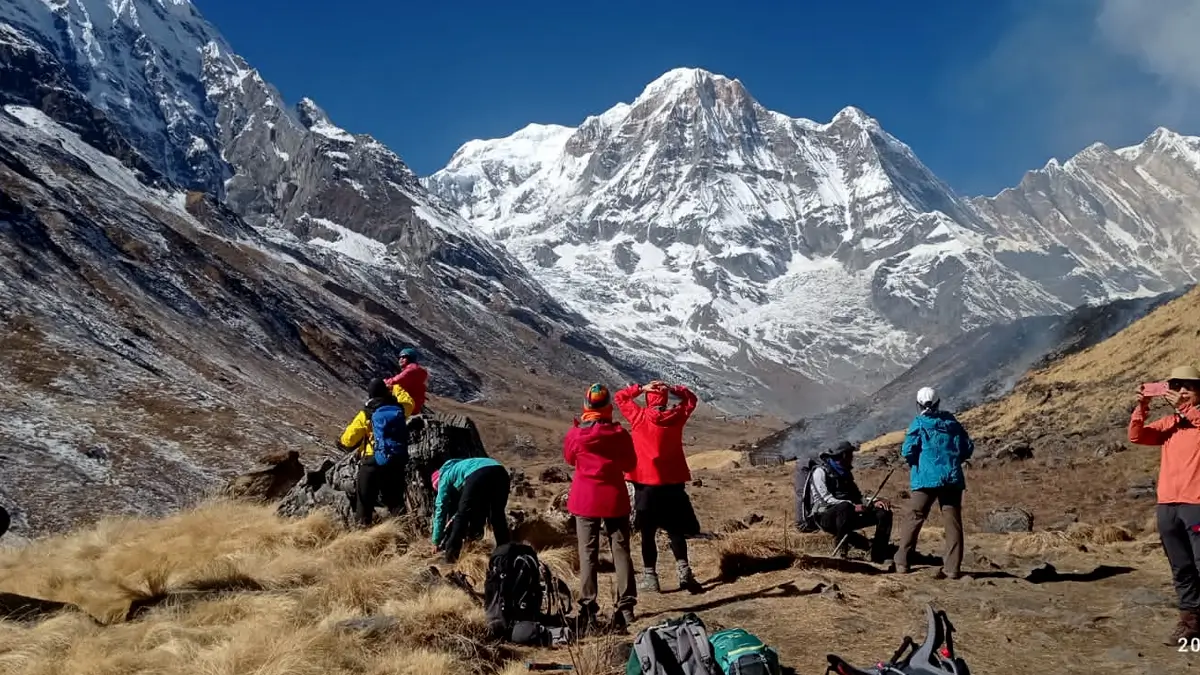
A short break during the Annapurna Base Camp Trekking journey
Annapurna Base Camp trek tour seasonal planning: When is the best time to go for it?
While with the recent road extensions and improved infrastructure, we can arrange the Annapurna Base Camp hike throughout the years, even during the times of the year known as off-seasons for high Himalayan adventures, summer and winter, spring and autumn still stand at the edge as the ideal seasons. March to May and September to November, typically spanning 3 months, are characterised by the most stable weather in the Himalayas.
Being the pre-monsoon and post-monsoon seasons, the Annapurna Base Camp trekking trails during these times remain mostly dry with minimal chances of rain and snow even at high altitudes like the ABC. Least concerned of floods, landslides, leeches, and extreme cold, you have the safest hiking conditions; if you are a beginner and do not want to deal with seasonal challenges, the Annapurna Base Camp Trekking Guide is best booked in spring or autumn.
Food and Accommodation Guide for Trek to Annapurna Base Camp: Where to stay and eat?
The Annapurna region is one of the most popular trekking destinations in the world, where you can find well-established teahouses throughout hiking trails offering you daily meals and places to stay. Typically, teahouses opened and managed by Himalayan locals provide you with traditionally furnished rooms with twin beds and simple bedding like mattresses, blankets, and pillows. Bathrooms and toilets are usually located outside of teahouses.
Likewise, meals are also served in common dining halls, including breakfast, lunch, and dinner, which generally consist of a mix of Tibetan and Nepalese dishes with some western options such as Dal Bhat, fried rice, noodles, pastas, pancakes, eggs, soups, teas, and coffee. Things like wifi, electricity, and hot showers are still a luxury, even if available; they often incur extra costs, so the trekking Guide to Annapurna Base Camp is to keep your expectations realistic.
Annapurna Base Camp Trekking Guide for the right permits: Do you need a special RAP?
No, unlike for the restricted areas treks in Nepal such as the Upper Mustang Trek, the Upper Dolpo Trek, the Kanchenjunga Base Camp Trek, and the classic Manaslu Circuit Trek, you do not need the special restricted area permit (RAP) to complete the Annapurna Base Camp Hike. What you will require is the Annapurna Conservation Area Permit (ACAP) and the standard Trekkers' Information Management System (TIMS) card.
However, if you are planning the combined Himalayan trips, which include travelling through the restricted areas, it is a must that you obtain the respective restricted area permit, whose price does differ from season to season, higher during the peak trekking and climbing seasons of spring and autumn. Now available online, the Nepal trekking permit fee goes for the conservation of the areas you are travelling through and is mandatory to enter the region.
Must have gears and equipment for the trek to the Annapurna Base Camp
Proper packing is one of the major keys to highly enhanced Himalayan journeys in Nepal, be it the Everest, Langtang, or Annapurna trekking or climbing. While booking our comprehensive Annapurna Base Camp Hike package, we do provide you with trek gear like a sleeping bag, warm jacket, rain poncho, complementary trek duffle bag, T-shirt, and trek map; well-broken-in trekking boots, pants, and poles are basics that you must have.
You can choose to carry all the way from your home country; you may even find them of better quality, or explore the tourist town, Thamel, once you land in Kathmandu, Nepal. If you are on extremely budget-friendly mode, consider renting and returning after the completion of the journey. Either way, do not forget to dress in layers, while the specific gear and equipment guide for the Trek to Annapurna Base Camp does vary based on the seasons you choose.
Annapurna Base Camp Guided Trek vs. without a Guide: Is it allowed?
No, free individual trekkers (FITs) are completely banned in Nepal, especially since April 1st, 2023. That means for journeying inside the country’s national parks, conservation areas, and registered areas such as the Annapurna Conservation Area, where the Annapurna Base Camp Hiking also takes place, it is a must that you at least hire a professional local guide. I.e., the Annapurna Base Camp solo trek without a guide is not feasible anymore.
Meanwhile, the guided treks in Nepal have multiple advantages. Locals, born and brought up in the Himalayas, know the terrain you are walking through from the heart and often go beyond to ensure that you achieve your dream Himalayan adventure. Well-trained and experienced, from expert navigation to managing the essential logistics and providing immediate assistance in emergencies such as altitude sickness, get your Annapurna Base Camp Trekking Guide now!
Conclusion
The Annapurna Base Camp Trek is famous for the greater diversity in both nature and culture, besides the epic mountain scenery in a single trip. From the lush subtropical forests to alpine meadows and observing the lives of Gurung and Magar people, the trekking Guide to Annapurna Base Camp is so that you keep yourself ready for the challenges that come with hiking into the Himalayas of Nepal and make the best out of it.
To be able to stand at the pristine Annapurna Sanctuary, especially when the morning sun lights up the majestic Annapurna I and surrounding ranges, and collect the memories that stay with you forever. We are at Mountain Monarch, taking bookings for the years 2026 and 2027 with fixed group departures in spring and autumn. Join one of them or plan your solo, private, and family treks, tours, and expeditions; we are here for you round the clock!