How to Train for Everest Base Camp: The fitness plan to consider before the trek
How to Train for Everest Base Camp: The fitness plan to consider before the trek
Updated on September 28, 2026
The Everest Base Camp (EBC) Himalayan Hiking, with a main intent to reach the base of the tallest mountain range in the world, is one of the most iconic trekking routes in Nepal. Rewarding anyone with a good level of physical fitness, with some preparation and training, walking through the heart of the iconic Khumbu Valley, a multi-day high-altitude trek in the remote Himalayas, miles away from modern-day facilities, it is, however, not to be taken lightly.
Therefore, here is a brief discussion on the training for the Everest Base Camp Trek, especially if you are planning in 2026 and 2027, suitable for both beginners and seasoned trekkers and climbers. Usually reaching the highest point at Kala Patthar that sits at an altitude of around 5,644 m above sea level, this is the guide on the Everest Base Camp trek fitness: is the Everest Base Camp trek difficult? So that you build what it requires for a memorable trip.
What to expect on the trekking trail to the Everest Base Camp?
As per the 16 days for the Everest Base Camp Hike Itinerary, Lukla is the official trek starting point, and in a round trip you cover 130 km/81 miles, walking anywhere from 5 to 8 hours on a daily basis. Mixed trails also include steep ascents and descents and, in the higher region, rugged terrain where the journey can get tougher due to the low oxygen and increased risk of altitude sickness that can affect anyone regardless of their experience and fitness level.
Though one of the best teahouse treks in Nepal with far better infrastructure than the remote and restricted trek routes like the Upper Dolpo Trek, the Kanchenjunga Base Camp Trek, and the Upper Mustang Valley Trek, it is best that you do not forget it is still a high-altitude Himalayan adventure. The higher you go, the more limited the options on amenities and the more unpredictable the weather. Everest Base Camp trek preparation is a must.
Is It Safe to Trek to Everest Base Camp?
Rated moderate in terms of difficulty, the trekking terrain includes walking through the lush forested areas and traditional villages near each other to alpine meadows and rocky cliffs just beneath majestic snow-capped mountain ranges, including the top of the world, Mt Everest (8,848.86 m), which is sure to be challenging but not unsafe. The locals from the Himalayas in general are welcoming and happy to help you in need.
Preparing hearty meals that keep your stomach full and warm and their genuine hospitality in your heart—it is who you return to time and again. Likewise, with the help of proper acclimatisation, hydration, an experienced guide, travel insurance, listening to your body, and eating healthy, even the terrain becomes manageable for a wide range of adventures, including beginners journeying in the Himalayan region for the very first time.
It helps you cope with the real challenges that await you in the Himalayas, such as consecutive days of hiking, steep uphill and downhill sections, thin air at high altitude, cold temperatures, carrying daysacks, and limited time for recovery. Increasing stamina, endurance, and also strength is further helpful for reducing injuries and accidents; the better prepared you are, the smoother the Himalayan trip becomes, including the Everest Base Camp hiking.
What are the minimum fitness requirements for the trek to Everest Base Camp?
While you may hire porters to carry heavy gear and equipment, we provide 1 porter per climber on booking. A daypack weighing 5 - 8 kg is for you to carry regardless. Likewise, one should be able to climb stairs without excessive exhaustion, hike uphill for extended periods, and recover quickly after physical activity, so it is a must that you are healthy. If you have any such issues with knees, heart, or lungs, it is better that you consult with authorities first.
How to train for the Everest Base Camp (EBC) Trekking?
Begin the physical training at least 2 - 3 months before the official Himalayan trekking departure dates, which we offer fixed group departures in the months of spring and autumn from March to May and September to November, including for the years 2026 and 2027, or plan a private and solo one for a more exclusive experience. We are capable of organising as per your area of interest, preferences, and requirements.
As per the step-by-step fitness preparation plan, in weeks 1 - 4, focus on building aerobic fitness. Then, in weeks 5 - 8, concentrate on increasing endurance and strength. Thereafter, weeks 9 - 12 will be the peak phase, during which you will begin trek-specific preparation with a gradual increase in intensity, which altogether ensures that it truly meets the standards required for a seamless mountain trek with a high success rate.
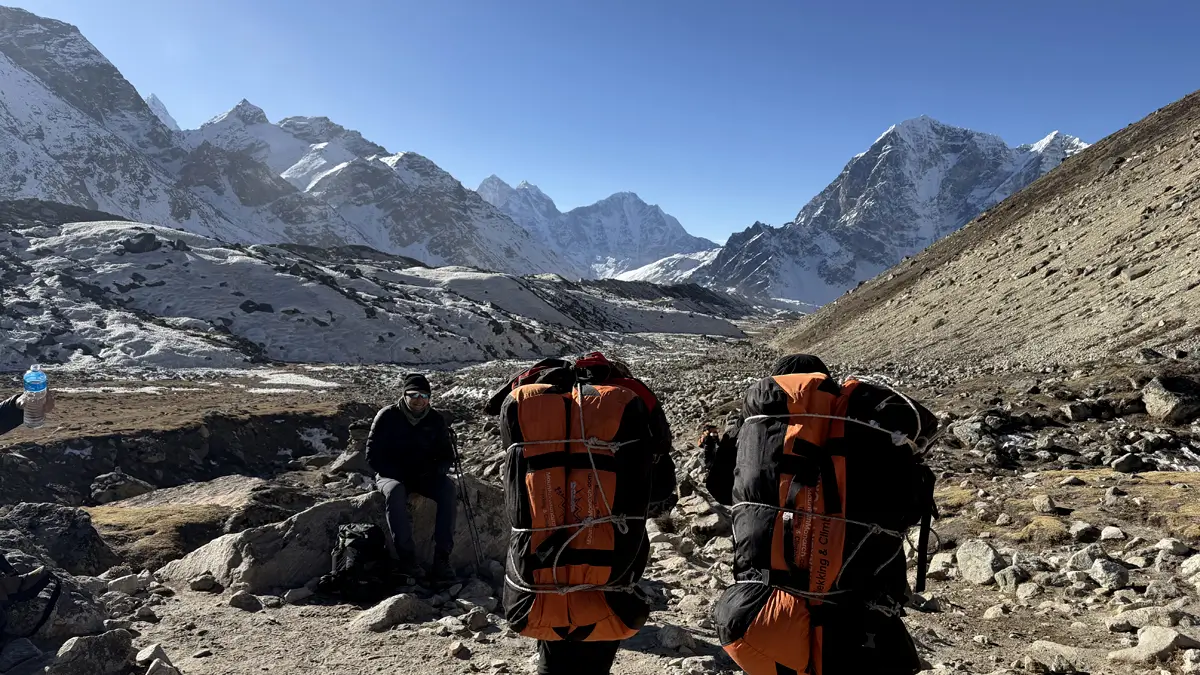
Short break time while the porters carry Everest Base Camp Trekking gear and equipment
Recommended Cardio Activities
Cardiovascular training for the Everest Base Camp hike is intended to strengthen the heart muscles and stamina and also help you lose weight and burn calories. In the Himalayas, where air pressure is low and so is the level of oxygen, lungs and hearts are required to work harder than normal to circulate blood in the body; here is a list of cardio activities to include in your training plan for trekking to the Everest Base Camp and increase the duration and intensity.
Hiking
Running
Stair climbing
Swimming
Cycling
Rowing
Strength Training for the EBC Trek
As also mentioned above, the journey for trekking to arrive at the Everest Base Camp includes multi-day high-altitude hiking, 5-8 hours daily, some days with steep ascents and descents and rocky and snowy trails, specifically from Lobuche to the Everest Base Camp, and during the side trip to Kala Patthar. Hiking the varied terrain while also carrying your daypack, it is a must that you have built strong muscles to handle it all; you can do this by activities such as:
Squats
Lunges
Step-ups
Planks
Glute bridges
Deadlifts
Calf Raises
Recommended Core Exercises
The Everest Base Camp Trek Training Plan is incomplete without including the exercises that help to improve your posture and enhance the backpack carrying efficiency to keep your body stable even on uneven terrains and maintain proper breathing mechanics at high altitudes. The core exercises strengthen the muscles of the abdomen, lower back, and hips, also ensuring proper transfer of energy between the organs involved to reduce injuries, so consider:
Planks and side planks
Russian twists
Mountain climbers
Bicycle crunches
Dead bugs
Hiking Practice, Flexibility, and Mobility
Other training to consider to prevent strains and injuries, improve recovery time, enhance balance and stability, and also reduce back and joint pain: focus on hamstrings, hips, hip flexors, calves, and lower back are activities that improve flexibility and mobility. Then the hiking practice on local trails with similar conditions is beneficial for the right kind of conditioning, test gear, improving confidence, and identifying physical weakness. So engage in:
Yoga
Stretching
Foam rolling
Mobility drills
Multi-day hiking to local terrain
Mental Preparation for Everest Base Camp
Cold weather, basic amenities, long days of walking, and physical discomfort—only maintaining the Everest Base Camp Trek fitness is not enough; it is only one part of the equation. Mental resilience is also extremely important to enjoy the trip to the fullest. It helps to remain positive throughout the journey, even during the most challenging moments, and focus on the good side, including strategies like:
Set realistic expectations and remain flexible to the most basic facilities available, which at high altitude can get limited to Dal-Bhat-Tarakarki in menus and rooms with twin beds shared between trekkers.
Remember the trek is not a race; practice patience, and in the Himalayas, going slow is actually going fast, and remind yourself to listen to your body and take breaks when needed.
Break the trek into tiny, tiny pieces, one goal at a time, visualising success instead of being overwhelmed by the greater distance to cover in an entire trip; stay positive.
Check whether you have the essential trekking gear and equipment, which, on booking with us, we provide for you to use and return. A sleeping bag, warm jackets, a rain poncho, a duffle bag, and a T-shirt for enhanced comfort, mobility, and warmth on cold days.
Common Training Mistakes to Avoid
Being able to walk 15-20 km comfortably, complete long hikes with elevation gain while carrying a daypack, recover quickly after strenuous activity, and maintain constant energy levels during the consecutive hiking days are signs that you are ready for the trek to Everest Base Camp. Rewarding anyone who enjoys long walks, nature, mountains, and a unique culture that is also shaped by the top of the world itself, there are some things better to avoid while training.
Starting too late and overtraining are both not good. The first one leads to inadequate preparation, while excessive exercise can cause fatigue and injury, and you may have problems even beginning the Himalayan trip. Do not ignore the strength training; outdoor training experience is invaluable, considering you will be journeying in a completely unfamiliar country and training for several days. Best of all, for specific guidance, stay in contact with local experts.
Can Fitness Prevent Altitude Sickness?
It is a misconception. No, maintaining a high fitness level for the Everest Base Camp trek alone does not eliminate the risk of altitude sickness. On rapid ascent to high altitude without proper acclimatisation, even elite athletes and gym rats can suffer from the symptoms of acute mountain sickness (AMS), the other name for altitude sickness, which, if ignored, can lead to fatal conditions like HACE and HAPE.
The key to preventing it, whether you are on the Everest Base Camp Hiking Trail or any other short, long, or mid-Himalayan journey, is adequate acclimatisation, whose golden rule is to hike up and sleep low whenever possible. While on the trail, ascend gradually without rushing the steps, stay hydrated, eat healthy, and rest when needed. Or simply book the 16 days Everest Base Camp Hiking itinerary package from Mountain Monarch that guarantees it all.
Conclusion
The life-changing trek to Everest Base Camp is challenging but achievable. It is not easy but also not dangerously difficult for those prepared and those who pay respect to the high altitude and the Himalayas. The success lies in consistent endurance training and leg and core strength with back-to-back hiking practice. It may not necessarily require hardcore workouts; follow this Everest Base Camp Trek preparation to pursue the trail with confidence.
Rewarding every committed healthy individual trained consistently for it. The proper training plan for the Everest Base Camp Trek regarding queries like, “Is the Everest Base Camp trek difficult? Is it safe to trek to Everest Base Camp? Is the Everest Base Camp trek easy?" In conclusion, it becomes manageable with the right training plan as suggested by licensed and experienced operator Mountain Monarch, with 4.6/5 ratings as per 51 Google reviews.