Packing List for Trekking to Everest Three Passes: Go Lighter, Go Higher
Packing List for Trekking to Everest Three Passes: Go Lighter, Go Higher
Updated on January 01, 2026
The Everest Three Passes Trek is arguably the most challenging and rewarding Himalayan route in the majestic Khumbu region of Nepal, home to the tallest mountain range in the world, Mount Everest (8,848.86 m). Named so for including navigation of three of the major high-altitude mountain passes of the Everest Himalayas, it is a more adventurous and off-the-beaten-path route to the popular Everest Base Camp Trekking trail.
For several days, you will walk above 3,000 m above sea level, where the oxygen is significantly low. Trails can be rugged, snowy, and full of steep ascents and descents; correct trekking gear and equipment here become essential to tackle the challenges more efficiently and at times are proven life-saving. So here’s the gear checklist for trekking to Everest Three Passes, a must-know Everest High Passes Packing Guide.
The Three Passes Trek Map: Understanding the Route
Three weeks is the standard Everest Three Passes Trekking Itinerary. Starting typically with a mountain flight to Lukla from Kathmandu, like any other Everest Himalayan trek and climb, such as the classic Everest Base Camp Trek, Mera Peak Climbing,Island Peak Climbing, Everest Circuit Trek, and even the Mount Everest Expedition. The Three Passes Trekking Map provides you with an outline of the breathing loop trek.
Up to Namche Bazaar, you follow the popular Everest Base Camp hiking route; thereafter, however, it goes through less-trodden trails via Thame, Lungden, Gokyo, and finally to Renjo La Pass. Then the second phase takes you to Thagna to reach Zhongla via Cho La Pass, further to Everest Base Camp via Lobuche and Gorak Shep. On the 15th to 16th, you finally make it to Kong Ma La Pass, concluding the trip; an enthralling experience awaits.
Why is packing smart essential for trekking to Everest Three High Passes?
The Three Passes Trek in the Everest Trekking and Climbing region involves long hours of high-altitude treks, almost 6-8 hours per day at least. The elevation gain is dramatic, and so is the weather that changes rapidly. Further, the steep ascents and descents, especially on rugged trails, can cause you extreme physical fatigue, and heavy packing for the Everest Three Passes Trek can slow down your journey.
Therefore, smart packing for Nepal treks is essential, so choose the right Everest region trekking equipment to take advantage of what you are carrying with you. Focus on proper weight distribution, weather adaptability, technical functionality, and safety at high altitude, being aware of potential ice, loose rocks, and glacial walks. A proper layering system for the Everest Trek ensures a smoother, faster, and warmer trip.
The base layers in clothing as gear and equipment for the Trek to Three High Passes Trek, must sit directly against your skin and dry quickly. Its purpose is to manage moisture and sweat by wicking it away from your body, maintain the core warmth, and prevent chills at high altitude, which is crucial for staying warm during the cold, especially at night and in winter. Avoid cotton; instead, include the following ones:
2-3 sets of merino wool or high-quality synthetic long-sleeved thermal tops.
At least 2 pairs of merino wool or synthetic thermal leggings.
Quick-dry trekking T-shirts and pants.
5-7 pairs of breathable underwear and at least 3 sports bras for women.
Insulting the Mid Layer
Mid-layer packing for the Everest Three Passes Trek traps heat and provides insulation. While you may have to keep on wearing and removing it frequently throughout the day, it is a must-have, especially during cold mornings and evenings, and it maintains your comfort. Make sure it does not restrict your arm movement, has space for ventilation, and is lightweight without bulk. In short:
Fleece jacket or pullover
Synthetic or down jacket
Outer or Shell Layer
As mentioned above, the weather in the Himalayas is known for its notoriously unpredictable nature. It can change in the blink of an eye; sunny in the morning, it can be rainy and windy in the afternoon, and in the evening, snowy, especially at high-altitude landmarks like the high mountain passes, and the outer shell is to keep you protected against these. Include:
Waterproof and windproof jacket like Gore-Tex
Waterproof and windproof pants
A heavy down jacket that is also breathable and allows moisture to escape.
Footwear and Handwear
You would not want your hands to be exposed to extreme cold, nor your feet, so footwear and handwear must not be missed to include in your Three Passes Trek Packing List. It helps you to endure long trekking days, steep uphill and downhill climbs, and freezing temperatures. They must be of high quality to sustain throughout the three weeks of high passes on the Everest Hike in Nepal.
Well broken-in, good-quality, sturdy trekking boots.
Lightweight shoes or sandals to wear in teahouses and camps.
2-3 pairs of thin and thick socks
Inner fleece gloves and insulated waterproof gloves.
Essential Trekking Equipment and Gear
The Three High Passes Trekking in Everest involves numerous days of high-altitude treks, reaching 5,000 m passes—not only one but three of them in a single trip. That is why reliable high-altitude trekking gear becomes a necessity. Though it is not clothing gear, for more enhanced safety, comfort, and performance, here is a list of some of the must-have gear while packing for Nepal treks.
Backpacks: 50-70L duffel bag; you may hire a porter and a 25-35L daypack to carry your daily essentials like water, snacks, a camera, layers, waterproofs, and personal items.
Sleeping gear: A -15 degree Celsius to -20 degree Celsius rated sleeping bag and optional liner are highly recommended.
Trekking poles: To navigate the rugged and steep ascents and descents more effectively, get sturdy trekking poles.
Personal hygiene and toiletries: Quick-dry towel, toothbrush and toothpaste, biodegradable soap and body wash, wet wipes, hand sanitizer, lip balm, sunscreen, and moisturizer.
First aid essentials: Diamox to prevent altitude sickness, ibuprofen or paracetamol, anti-nausea medication, blister care kit (band-aids, moleskin, tape), anti-diarrheal medicine, oral rehydration salts, antiseptic cream, and personal medication if any.
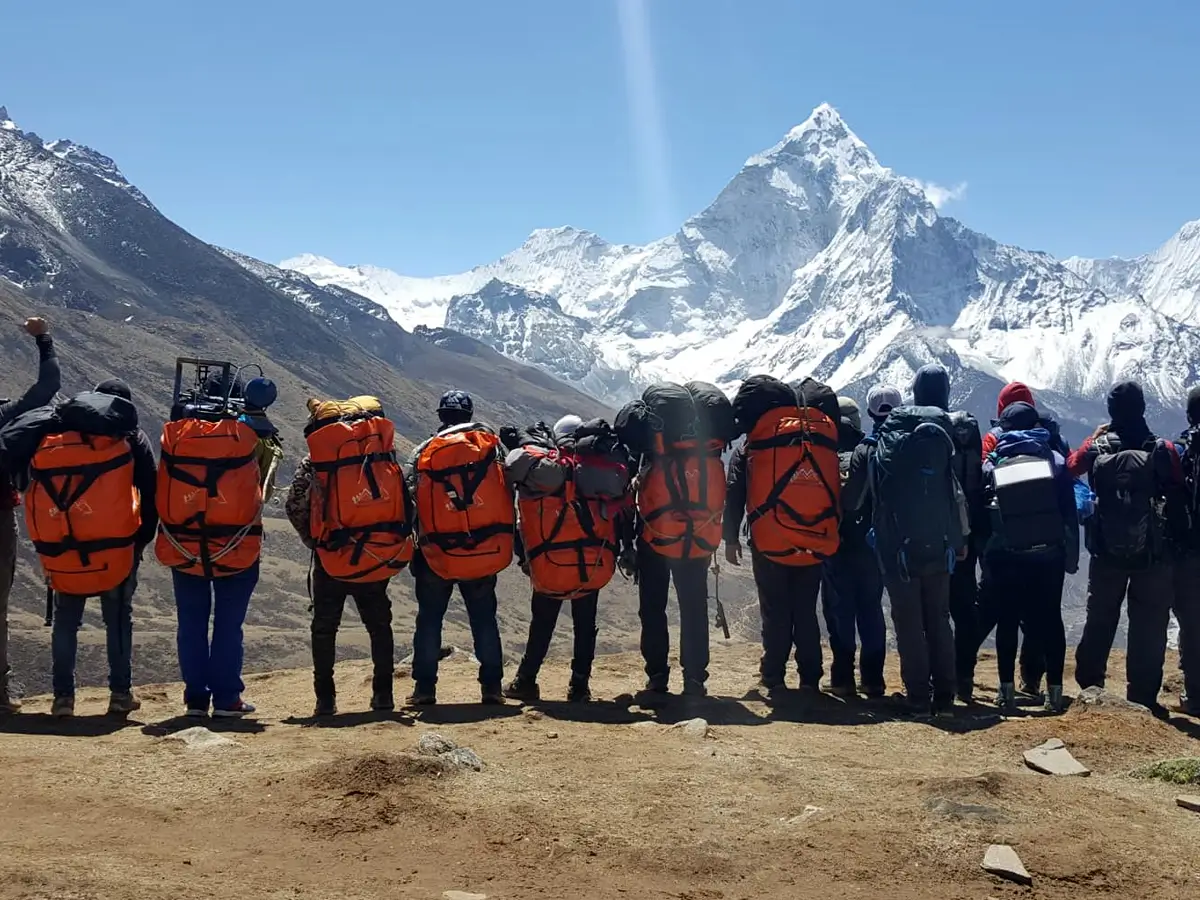
Ready for the Everest Three Passes Trek with all essential trekking gear and equipment
Do you need technical gear for the Three Passes Trek?
Though the highest trekking peak in Nepal, Mera Peak is non-technical in comparison to Lobuche East Peak Climbing and Chulu West Peak Climbing; therefore, technical gear and equipment may not be mandatory. However, as you know, prevention is better than cure, and better support will increase confidence. Make sure the technical gear and equipment for the Three High Passes Trek are resistant. In short:
Technical Gear: Lightweight crampons or microspikes, carabiner, multi-tool knife, thermal blanket, whistle, and waterproof dry bags to cover electronics and documents.
Electronics for the trail: High voltage power bank, solar charger, power adapter, camera or GoPro, and charging cables, as electricity can get very scarce at higher and more remote areas.
Local SIM Card: Wifi and internet connection are usually available at some additional cost in lower and popular villages, but are almost nonexistent 5,000 m above sea level, so it is wise to purchase a local SIM card like NTC or Ncell and a data package.
What are the must-have documents to trek to the Everest Three Passes?
For any sort of outdoor adventure inside its national park, conservation, and restricted areas in Nepal, it is a must that you obtain entrance permits. Since the Everest Three Passes Trekking is also within the Sagarmatha National Park, further listed as one of the natural UNESCO World Heritage Sites in the country, the Everest High Passes Packing Guide is incomplete without obtaining mandatory permits. Along with it, you also need.
A passport with at least six months of validity for visa issuance.
Photocopies of the visa.
A few pairs of passport-size photos.
Travel insurance with emergency helicopter evacuation.
Adequate Nepalese rupees, as ATMs are usually not available and can be unreliable.
Where to get the Everest Three Passes trekking gear and equipment?
While you can choose to carry all the essential Everest region trekking equipment and high-altitude trekking gear from your home country, you do not have to worry about whether you may find them in Nepal or not. In the touristic heart of the Kathmandu Valley, which is also the capital city of Nepal, Thamel, you can find a wide range of trekking gear and equipment, including Everest Three Passes Trekking Equipment.
Complete your gear checklist for trekking to the Everest Three Passes. If anything is missing or has to be added as briefed by an experienced guide, Thamel has it all. Or, book your Everest Three High Passes Trek with Mountain Monarch. Our comprehensive package cost includes provision of all quality trekking gear and a supplementary oxygen cylinder, the Everest Three Passes Trek Map, and one porter per trekker to ensure you have a hassle-free experience.
Things not to pack for Trekking to the Three High Passes in Everest
While you may choose to hire porters to carry your high-altitude trekking gear in Nepal, including the gear and equipment for the Three High Passes Trek, there’s a limitation on how much they can carry at once, which is usually not more than 25 kg shared between two trekkers. Therefore, we suggest that you avoid packing heavy books, multiple jeans or cotton clothes, large toiletries, and extra shoes that you may not use.
Excess electronics may not come into use and so are unnecessary gadgets. Too many snacks can make your backpack heavier, while they in general are generally provided on the trail at teahouses. Go lighter; carry only what those necessary. If you have carried more than required, you may leave them behind at Kathmandu before the official trip departure day or at the office of Mountain Monarch at Hattigaudha, Kathmandu, Nepal.
High-altitude trekking gear packing tips: Go Lighter, Go Higher
There are several things trekkers and climbers can do to ensure they have all the essentials, but without weighing down the packing for the Everest Three Passes Trek, and here are some of the most preferred ones:
When following the layering system for the Everest trek, pack a merino wool layer to minimize washing and drying.
Include a multipurpose Everest trekking clothing list.
To make it within budget, you can always rent in Kathmandu.
Try to make sure the high-altitude trekking gear packing weight is under 12-15 kg.
Leave your extra baggage in Kathmandu or our office, etc.
Conclusion
Having the right Everest Three Passes Trek packing list ensures a smooth, enhanced, and comfortable experience from start to end. When you know you have proper layers, technical gear, and health kits, your confidence level also increases significantly, including safety across Renjo La, Cho La Pass, and Kongma La. Follow this comprehensive Gear and Equipment for the Three High Passes Trek Guide for better preparation.
It is with an insight into the Everest Clothing List, an exact gear checklist for trekking to Everest Three Passes, and a well-structured Himalayan trekking packing list, so you stay warm, safe, and comfortable without stuffing your backpack. Or buy a comprehensive Everest Three Passes Trekking package from Mountain Monarch that includes essential trekking and climbing gear.Contact us now and reserve your seat for 2026 and 2027.