How Tall is Island Peak Really? Is it Too High for Beginners?
How Tall is Island Peak Really? Is it Too High for Beginners?
Updated on September 10, 2026
Island Peak, also known as Imja Tse, is one of the most popular trekking peaks in the Everest Himalayas of Nepal. Major highlights include the breathtaking views of some of the world’s highest mountains, including Lhotse (8,516 m, the 4th highest mountain peak in the world), Makalu (8,485 m, the world’s fifth tallest peak), Nuptse, Baruntse, Chamlang, and Mt. Everest (8,848.86 m, the top of the world on the way). A memorable high-altitude mountaineering awaits.
Usually beginning with an adventurous mountain flight of 25 - 35 minutes operating from Ramechap, Manthali, during the peak trekking and climbing seasons of spring and autumn, like the classic Everest Base Camp Trek, in a while, however, you follow the comparatively lesser-trodden trekking trail, and it may spark curiosity: How tall is Island Peak really, and is it too high for beginners? So here is the guide on the actual Island Peak height.
What is Island Peak?
Adjacent to the tallest trekking peak in Nepal, Mera Peak (6,476 m), Island Peak near Mount Everest is one of the most popular beginner-friendly peak climbs, often combined with the classic trek to the Everest Base Camp for better acclimatization opportunities. Or, you may choose to attempt the Mera Peak and Island Peak climbing, suitable for seasoned trekkers familiar with high-altitude trekking and climbing conditions.
Named Island Peak in 1953 for its island-like structure rising above the sea of glaciers as seen from Dingboche, moderately technical as compared to the Baruntse Peak Expedition, the Ama Dablam Expedition, the Manaslu Expedition, and of course the Mount Everest Expedition, slightly more technical than Mera Peak Climbing, and a perfect blend of a high Himalayan trek, a glacier hike, and basic climbing skills, it ensures you an excellent introduction to climbing.
The Standard Height of Island Peak (Imja Tse)
A part of the Mahalangur Himalayan range, the official Island Peak altitude is 6,189 m/20,305 ft above sea level within the Sagarmatha National Park, a UNESCO World Heritage Site that is further home to the adventurous Everest Three Passes Trek, the Gokyo Lakes Trek, the Everest Circuit Trek, and also the Lobuche East Peak Climbing route. Standing at the center of a vast sea of glaciers, it was later on named Imja Tse in 1983 by the Nepalese authorities.
Squarely in the 6,000 m realm, to reach here, at first it involves several days of high-altitude trekking, 3,000 m above sea level, starting from where the level of oxygen in the air begins to drop significantly. Only from the Island Peak Base Camp do you start to climb, staying at camps that our experienced team from Mountain Monarch, upon choosing the comprehensive climbing package to Island Peak, sets for you, including a separate kitchen.
How High Is Island Peak Compared to Other Himalayan Peaks?
While the Island Peak (Imja Tse) summit does not come across the giants like Everest (8,848.86 m), Lhotse (8,516 m), Makalu (8,481 m), and Cho Oyu (8,188 m) within the Khumbu region, however in comparison to similar Nepal Mountaineering Association (NMA) trekking peaks in Nepal such as Lobuche East (6,119 m), Yala Peak (5,732 m), and Pisang Peak (6,091 m), it is a bit higher with equally easier logitsical management.
It is still one of the easiest and most popular 6,000 m peaks in Nepal, serving as the perfect practice and training ground for mountaineers preparing for their next big expedition yet still delivering a true alpine climbing experience like never before. Ideal in position, including journeying through the diverse landscapes (dramatic unfolds in each step), and direct access from the Everest Base Camp Trekking trail, say less and book now.
Is Island Peak the highest island peak? Clearing the common misconceptions
No, despite its name, unlike the Puncak Jaya, often also referred to as Carstensz Pyramid in the Island of New Guinea (Papua, Indonesia), Island Peak is not literally located on an island. It is only named so for its island-like appearance; Island Peak Nepal height in isolation above the Imja glacier and Chhukung Valley, with the current GPS surveys and NMA records confirming its height to be 6,189 m, not 6,165 m. No, as Ama Dablam stands at 6,189 m, it is not taller.
With a reputable guide service such as Mountain Monarch. Well-trained and experienced guides like Ngima Sherpa and Migma Chiri Sherpa, who have dedicated themselves to mountaineering, basic fitness, and high-altitude trekking, have experience best done at 5,000 m above sea level, whether in Everest or other regions such as the Manaslu Circuit Trek (5,106 m) and the Annapurna Circuit Trek (5,416 m). It is achievable for determined first-timers.
Elevation Gain During Island Peak Climbing from Chhukung
As per the 16 days itinerary for climbing Island Peak that we at Mountain Monarch are offering, considered best for the years 2026 and 2027 with the acclimatization days at Namche Bazaar, Dingboche, and Island Peak Base Camp above the village of Chhukung, you begin hiking from Lukla after a mountain flight from Kathmandu, which sits at an elevation of around 1,400 m above sea level. Counting from here, the elevation gain is significant.
So it is from Lukla, located at approximately 2,860 m above sea level. During the trekking days, it is almost 5 - 7 hours of daily walk covering between 5 - 12 km (3 - 7.5 miles), sometimes more, where the Chhukung (4,730 m/15,518 ft) serves as the official launching point. From here are Island Peak Base Camp (5,100 m), High Camp (5,600 m), and the final Summit Push (6,189 m), which are respectively a gain of 370 m, 500 m, and 589 m, a total gain of around 1,500 m.
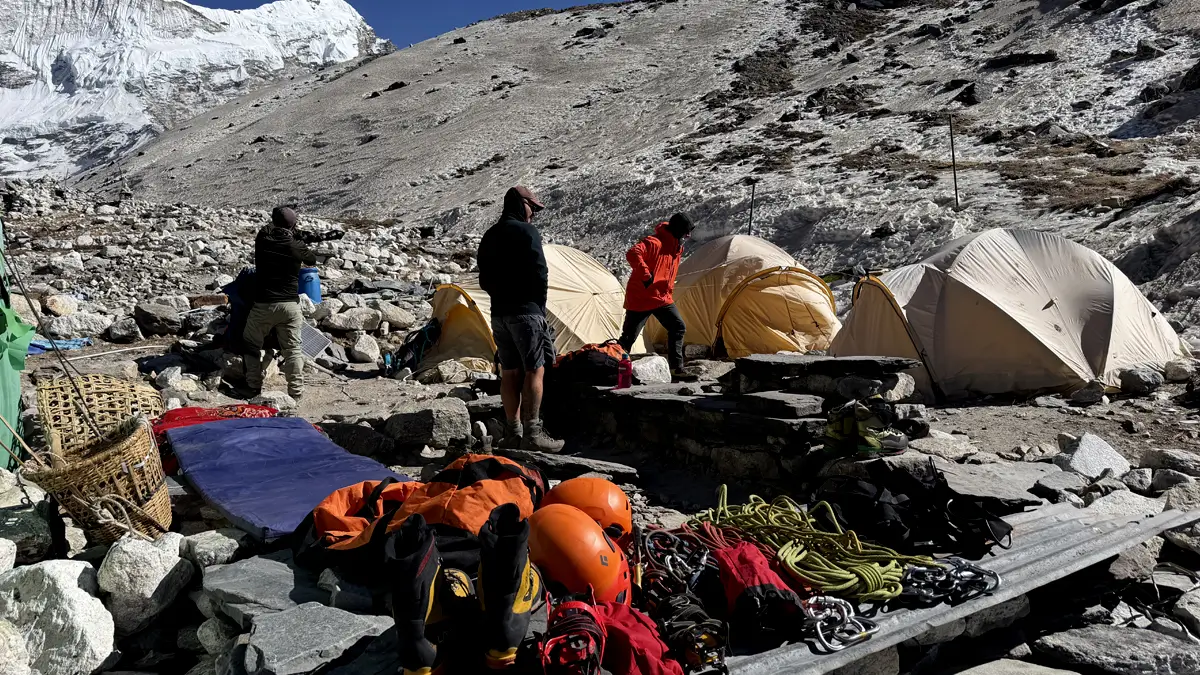
Preparing for the final Island Peak Summit at Island Peak Base Camp above Chhukung
Why spend an extra day at the Island Peak Base Camp Altitude?
Trek beginning from 2,860 m at Lukla to reaching Island Peak Base Camp at 5,100 m; the gain in altitude can not be ignored, and on rapid ascent to further without proper acclimatization, it can easily trigger the symptoms of altitude sickness, also called acute mountain sickness (AMS). With more than two decades of experience, we are known for high-quality services. Whenever possible, we prioritize your health, safety, and well-being.
That is why, before you officially attempt the real Island Peak Climb, with spare days at Island Peak Base Camp, you would have enough time for a last-minute gear check, adequate time for resting, high camp hiking, and rotation to follow the golden rule to ensure proper acclimatization and that your body has fully adapted to the challenging Himalayan surroundings. Expert mountain guides share essential safety tips and climbing skills; do be attentive.
What happens 6,000 m above sea level on the journey to climb Island Peak?
From Base Camp Island Peak onwards, you will journey 5,000 m above sea level, where air molecules are spread wider apart, atmospheric pressure drops to roughly 47% of the sea level value, and it is observed that at such height, when the human body is forced to operate, the heart pumps faster and also accelerates respiratory fluid loss. It does not take long to worsen the symptoms of altitude illness to severe conditions like HACE and HAPE.
Even while resting, you can experience the increased breathing rate. Though it may not be as bad when journeying through the Everest death zone at 8,000 m above sea level, it is still not to be taken lightly. A positive mindset to be able to picture the success and the right attitude; instead of competing with mountains and teammates, going slow and steady is extremely important. Remember, in the Himalayas, it is they who have the last call, not us.
Is Island Peak Too High for Beginners? Who may succeed?
The short answer to it is no. Although at last it largely depends on the level of the beginner, whether completely unfamiliar with high Himalayan adventures or seasoned trekkers ready to start a mountaineering career, as long as you have prepared yourself for the potential challenges that the Himalayas in Nepal are known for, such as changing Himalayan weather, rugged terrain, remoteness, and high altitude, challenging you time and again.
It demands a good level of both mental and physical preparation. Begin at least 3 - 6 months before, including ample cardiovascular activities such as hiking with a backpack that mimics the trekking and climbing conditions in Nepal, swimming, and cycling to build your physical fitness. Then there are hardcore squats, lunges, step-ups, and sit-ups to improve strength and endurance. It is best to first go on similar local multi-day treks or climbs.
How to tackle Island Peak Elevation? Some of the essential tips
Training specifically is something that you do before you officially begin the Himalayan trip to Island Peak. Prepare with the above-mentioned physical activities and exercises, and once you pursue the Island Peak trekking and climbing route, always remember to acclimatize properly. To adhere to the golden rule, spend at least one additional night in the lower region if there is significant elevation gain another day, incorporating a side hike up and a descent.
Likewise, even the notoriously unpredictable Himalayan weather at certain seasons calms down for a bit, so you must choose the right time of the year, which is spring and autumn. We have fixed departures that you can join in a group or plan solo and privately. Remember, it is always better to book with reputable local agencies or at least hire a professional mountain guide who knows the Himalayas by heart and pack smart and light with the right gear and equipment.
Where can you get equipment required for the climb to Island Peak?
Thamel, the infamous tourist town of the Kathmandu Valley. If you wish to bring the high-quality ones from your hometown, it's an excellent choice; otherwise, also in Thamel you can find options from purchasing the new ones to renting and borrowing. Whether you can stay at such a great altitude as such a great altitude of Island Peak, stay warm and comfortable, and also increase mobility, proper gear is essential, including well-broken-in sturdy boots.
Then the down jacket for clothing in layers is basic and usually for you to arrange. If you are planning Island Peak as your ultimate Himalayan adventure, completing a single trip only, the most budget-efficient option is purchasing our comprehensive Island Peak Expedition package. On booking with us, we not only provide all camping and climbing gear and equipment but also an oxygen cylinder with arrangements for 1 porter per climber.
Conclusion
Knowing how high Island Peak is is only a first step when the peak is the gateway to the world of thrilling high-altitude mountaineering with guaranteed mind-blowing scenery and doable technicality, and when you stand on the summit, the profound sense of adventure and accomplishment is beyond explainable in words only. Elevation gain during the Island Peak Climbing from Chhukung: you can estimate that it ain’t no joke.
Conquerable with proper planning, respect for altitude, and the spirit of adventure, even by beginner climbers, especially when under the guidance of professionals such as Mountain Monarch, Island Peak is an achievable dream to begin preparation now. Contact us now. Let us know your query; we are happy to answer it for you and reserve your spot with confidence. With us, you are in the right hands, with 4.6/5 Google ratings as per 51 reviews.