The Timeless Charm of Tengboche Monastery: A Sacred Gem in the Everest Himalayas
The Timeless Charm of Tengboche Monastery: A Sacred Gem in the Everest Himalayas
Updated on August 25, 2026
Nestled high in the heart of the iconic Khumbu region, Tengboche Monastery is one of the most revered spiritual landmarks in the Everest Himalayas. Lying on the main Everest Base Camp Trek route, it serves as one of the major stopping points, a perfect spot for acclimatization before you go higher or marvel at the stunning surrounding Himalayan panorama. For the right blend of nature, culture, and spirituality, remember the name “Tengboche Monastery”.
So let us take you through what makes the monastery at Tengboche special and why it is a fantastic destination for a short Everest trek to take a quick glimpse at the region for those restricted by time, health, or other conditions. Is it the Tengboche elevation and Tengboche temperature or what? Here are some of the must-knows about the Tengboche Monastery and village, including the Lukla to Tengboche distance.
Where is Tengboche Monastery located?
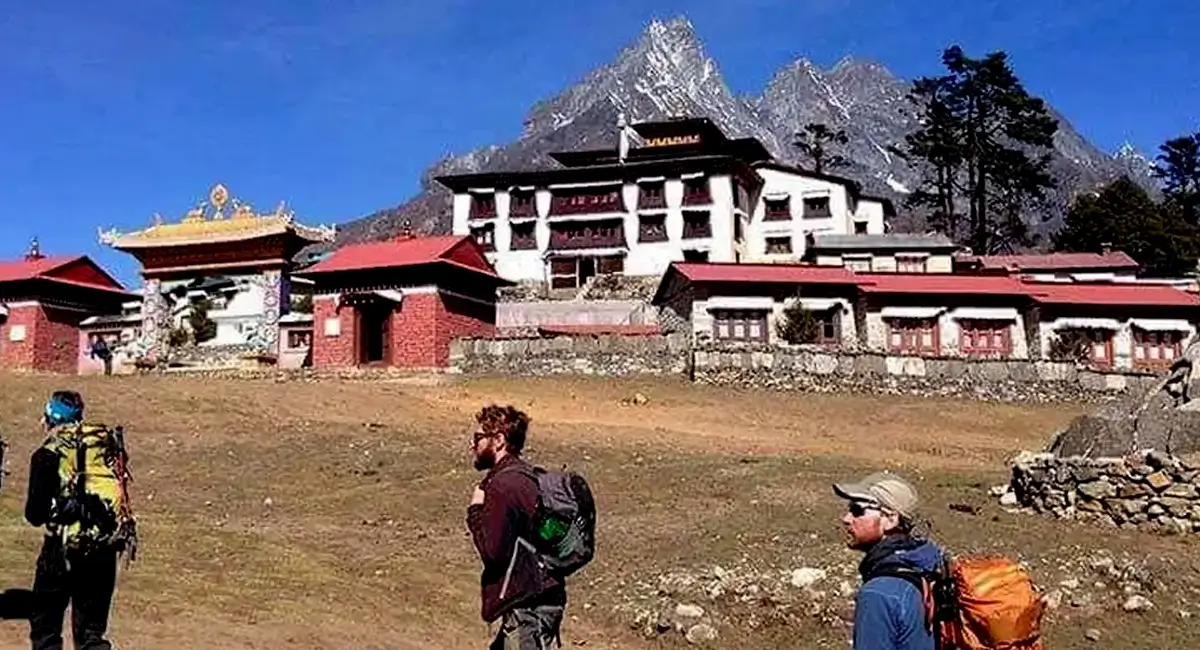
Perched on a hill at the meeting point of the Dudh Koshi and Imja Khola (rivers), Tengboche Monastery is situated in the Khumbu region within the boundaries of the larger Sagarmatha National Park, which is one of the natural UNESCO World Heritage Sites along with the Chitwan National Park. In between the traditional Sherpa villages of Namche Bazaar and Dingboche, with the stunning Mt. Ama Dablam as a backdrop.
In the Solukhumbu district of northeastern Nepal, it provides you with one of the finest Everest views; hence, it is also regarded as one of the best Everest viewpoints, often visited as a side trip once in the Tengboche village for proper adaptation to the challenging Himalayan surroundings. However, its introduction is not limited to that; it plays an important role in preserving the region's ancient culture, traditions, and spiritual beliefs.
The History of Tengboche Monastery
Standing tall even after a major earthquake in 1934 and a fire in 1989, Tengboche Monastery dates back to 1916 and was founded by Lama Gulu. It belongs to the Nyingma lineage of Vajrayana Buddhism and is the center of spiritual life for the local Sherpas living in the region, in harmony with other ethnic communities of Nepal who keep a strong faith in Buddhism. A philosophy of life which is associated with world peace, harmony, and non-violence.
The living cultural and spiritual heritage features colorful walls, intricately carved wood with holy chants, golden roofs, and murals representing the rich artistic heritage of Himalayan Buddhism. Inside are the paintings of Buddhist deities and sacred mandalas with the steps of life and Buddhist teachings, and you can observe the daily life of monks, prayers, and ceremonies, and also ask for blessings, including adventurers for safe passages ahead, and the practice continues.
How high is the Tengboche Monastery?
While the Tengboche elevation might not be as high as other major highlighted landmarks of the Everest trekking and climbing regions such as Kala Patthar (approx. 5,545 m - 5,644 m), Everest Base Camp (around 5,364 m), and Gokyo Lakes (4,700 m - 5,000 m), it cannot be sidelined that it still lies 3,000 m above sea level, starting where the presence of oxygen in the air begins to drop significantly. I.e., it still sits high in the Himalayan landscape.
Specifically, the Tengboche altitude is around 3,867 m above sea level, right at the center of a unique pyramid-shaped peak like Mt. Ama Dablam, often also referred to as the Matterhorn of the Himalayas. So it is still a must that you maintain your pace, keep yourself hydrated, and head higher only after proper acclimatization to enjoy the open and wide mountain views, crispy mountain air, and alpine vegetation to the fullest in and around the Tengboche monastery.
Is the Tengboche temperature bearable?
Yes, mid-altitude; neither too high. Lower compared to the highest points you reach during the Mera Peak Climbing (6,476 m), Island Peak Climbing (6,189 m),Manaslu Expedition (8,163 m), and Everest Expedition (8,848.86 m), and higher than the Annapurna Panorama Trek (3,210 m), most of the time the Tengboche temperature is manageable. Specifically, it does vary between day and night, yet up to here, you won't have to worry about extreme cold and snow.
However, it is a must to keep in mind that even during the times of the year taken as peak seasons for high-altitude treks and climbs, spring and autumn, like for journeying to other high Himalayan destinations to Tengboche, you may also notice the change in temperature in a single day. I.e., early mornings and nights can be cold, while the days are much warmer and comfortable with shining sun and mild temperature.
Tengboche Nepal Weather Throughout the Year
In Nepal, spring, summer, winter, and autumn—four of the four seasons—typically span for 3 months and are known for the specific climatic conditions they bring with them, including in and around the Sagarmatha National Park, i.e., the Everest Himalayas, where the Tengboche Monastery falls. From March to May is the spring season and features favorable weather, which is usually known to be extremely unpredictable in the Upper Himalayas.
Thereafter is summer, also called the monsoon season, and is often noted for rainy weather when most of the trekking regions experience heavy rainfall, and Tengboche is no different from June to August. Then there is autumn, which typically spans from September to November and features the clearest skies with longer daylight hours. At last, winter is cold, and higher in the Himalayas, it gets unbearable with heavy snow, so expect colder temperatures at Tengboche as well.
Trekkers made it to the cultural heart of the Everest Trekking and climbing region, Tengboche Monastery (3,867 m)
What is the Distance from Lukla to Tengboche?
Yet another frequently asked question about Tengboche village and monastery is its distance from the place which is known as the official gateway to the Everest trekking and climbing region, including for off-the-beaten Everest Treks like the Everest Three Passes Trek, Gokyo Lakes Trek, and the Everest Circuit Trek, Lukla. In general, before you begin hiking to reach Tengboche, you fly over to Lukla, and it is called the Lukla to Tengboche Trek.
Approximately 30 to 35 kilometers in distance based on the specific trekking route chosen and side trips, you will typically cover in 3 to 4 days with a hike to Phakding, Namche Bazaar, an acclimatization day at Namche Bazaar, and then finally to Tengboche itself. If you take the Everest view trek from here, you start to retrace the route back; otherwise, go even deeper into the Sagarmatha National Park, usually to Everest Base Camp (EBC) and Kala Patthar.
Finding Comfort: Himalayan Lodge Tengboche and Tengboche Guest House
If you are worried about where to stay during your visit to Tengboche, you will be delighted to come across a great variety to choose from. From budget-friendly simple teahouses offering twin beds, bedding, and typical Nepalese and Tibetan dishes to lodges and guest houses with better facilities, Tengboche won’t disappoint you at all. For an extra cost, up to here you may even find private rooms with attached bathrooms, a heating system, and a wide range of meals.
These are things of luxury in most of the remote high Himalayas of Nepal, such as seen during the Upper Dolpo Trek, the Kanchenjunga Base Camp Trek, the Rupinala Pass Trek, and the Tsum Valley Trek. Let us know what your preferences are and how you are planning the Everest trek to Tengboche and beyond. Budget luxury, with a family of aged members and kids, or young adults, we guarantee premium services at a reasonable price as per your choice.
Continuing the Journey: Tengboche to Dingboche
After exploring the monastery, most trekkers continue from Tengboche to Dingboche, which takes you from 3,867 m to 4,410 m with over 10 - 12 km distance in 6 to 8 hours, including breaks for tea and lunch. Initially, it is a descent through forests and is a gradual ascent, including crossing the Imja Khola River through Pangboche, one of the ancient Sherpa towns with more open valleys and mountain views.
Going further higher from here, the trail feels secluded. The shift from landscapes and air to rugged terrain and crisp can be vividly observed. From dense forests to alpine meadows dotted with stone-walled farms, yak pastures, and sparse settlements, all at the center of the sky towering snow-capped peaks such as Lhotse, Imja Tse (Island Peak), Thamserku, and Kangtega, while the Ama Dablam remains the prominent one, it is a rewarding experience overall.
The Ultimate Goal: Tengboche to Everest Base Camp
The hike to Everest Base Camp from Tengboche is when the weeks of preparation, acclimatization, and determination become fruitful. Leaving Tengboche, Dingboche, and Lobuche behind, you leave your belongings at Gorak Shep and trace the route to the iconic Everest Base Camp (5,364 m), where brave mountaineers and climbers in peak seasons stop before attempting the challenging Everest summit.
Right at the base of the top of the world, surrounded by majestic snowy peaks with refined views of Khumbu glaciers, icefall, moraine above, and valleys below, the scenery is simply out of this world. The sense of adventure and achievement at its peak, filled with the serene spiritual energy of mountain giants deep into the blue sky and the closest embrace of Mt. Everest (Sagarmatha in Nepal and Chomolungma in Tibet), gets ready for a life-changing experience.
The Famous Mani Rimdu Festival and essential tips
The Mani Rimdu festival, which spans 19 days, on the founding of Buddhism by Guru Rinpoche Padmasambhava at Tengboche Monastery in the Everest Himalayas of Nepal, is where it takes place. In the first 16 days, monks immerse themselves in deep, private meditation and construct an intricate Sanda Mandala; i.e., only the three days are open to the public to take part, observe, and collect blessings, featuring three distinct ceremonial phases.
Wong (empowerment) is aligned with the full moon, Chham (masked dances) reenacts the victory of Buddhism and wards off evil spirits, and last but not least is the Jinsak (Fire Puja), when a sacred fire ceremony is performed in the monastery courtyard. Often coinciding with the autumn season in the months of October or November, do check the Tibetan lunar calendar to relish the immense cultural insights and be part of the ceremony.
Conclusion
The unique blend of spirituality, history, culture, and natural beauty is what makes the charm of Tengboche Monastery timeless, including for the years 2026 and 2027. It is the place where the spiritual and sublime converge and attract pilgrims, trekkers, and adventurers from around the world. If you are planning, let us know. Mountain Monarch, based in Kathmandu, Nepal, excels in offering personalized Himalayan holiday trip experiences and itineraries.
Whether you wish to gaze at Ama Dablam from the Himalayan lodge Tengboche window and continue the Everest Base Camp hike or complete the Lukla to Tengboche Trek, Namche to Tengboche hike for a moment of profound connections, contact us, share your travel goals, what your dream Himalayan adventure looks like, and fully focus on making the best out of the journey without any hassle from start to end. Our bookings are open!