Mastering the Annapurna Circuit Altitude: How High Do You Go?
Mastering the Annapurna Circuit Altitude: How High Do You Go?
Updated on May 03, 2026
The Annapurna Circuit Trek is known for its mix of reverence for encircling the 10th-highest mountain in the world, Mt. Annapurna, with a little bit of healthy fear. Crossing one of the high mountain passes, Thorong La Pass (5,416 m), with a possible side trip to one of the world’s highest lakes, Tilicho Lake, and journeying through the deepest gorge on earth, Kali Gandaki, the round trip to Annapurna ensures you an adventurous Himalayan endeavor.
Then why is it feared as well? Well, while the scenery is legendary when you head deeper and higher into the Annapurna Conservation Area, also into the trans-Himalayan rain shadow area, the Annapurna Circuit's elevation is the true protagonist. On rapid ascent without proper acclimatization, anyone can suffer from the symptoms of altitude sickness, so you must understand the Annapurna Circuit elevation profile.
How high is the Annapurna Circuit Trek?
Based on 16 days for the Annapurna Circuit Trekking Itinerary, the highest point you reach is at the Thorong La Pass, which measures in at about 5,416 m/17,769 ft above sea level in elevation. Starting from Dharapani, which sits at around 1,860m, to reaching here with side trips to iconic landmarks like the Tilicho Lake and Muktinath Temple, both of which carry cultural and religious importance as well, the elevation gain is significant.
The entire Annapurna Circuit Trek route ranges between 760 m and 5,416 m as the journey begins from Kathmandu with a drive to Besisahar (760 m), Bulbhule (840 m), and then Dharapani (1,860 m). What you have to understand here is that 3,000 m above sea level, the air becomes thinner, and so does the level of oxygen, and even a shorter hours-long trekking journey can feel tough. Therefore, it is an insight into the trek Annapurna Circuit elevation.
Around the Annapurna Trek Altitude Experience
The trekking journey to complete a round trip of Mt. Annapurna begins from warm and green valleys filled with the more compact traditional villages of Gurung and Magar and terraced farms. In about 760 m - 2,500 m river valleys, waterfalls, and suspension bridges with a comfortable level of oxygen, up to here, it is a pleasing nature escape. Then, as you go higher from Chame, the air gets crisper, and mountain views open up further.
The forests begin to thin out from mid-elevation on the Annapurna Circuit Trek at about 2,500 m - 3,500 m. If rushed, trekkers may begin to notice the mild altitude effects such as shortness of breath, reduced stamina, and headaches. Where 3,500m - 5,416m above sea level is the high-altitude zone, including Manang, Yak Kharka, Thorong Phedi, and Thorong La Pass. With sparse vegetation and villages, these are also the most rewarding sections.
Annapurna Circuit Trek Altitude: Settlement by Settlement
The classic trek starts from Dharapani to Chame. With the recent road extension, you can directly drive through Besishar (760 m) and Bulbhule (840 m). Likewise, when you know the elevation of key stopping points, it helps with better physical and mental preparation, which is essential for a smoother and higher success rate of making it through the Trek Annapurna Circuit elevation. Here’s the settlement-by-settlement Annapurna Circuit Trek altitude guide:
Around the Annapurna trek's altitude is not just a number. As mentioned above as well, altitude directly affects your body. If you ascend to high-altitude landmarks without proper acclimatization, 3,000 m above sea level, from beginners to seasoned trekkers, old to young, and even the fitness freaks with excellent physiques, can see the symptoms of altitude sickness, also called the acute mountain sickness (AMS).
As you trek higher, the level of life gas (oxygen) decreases, and energy drains faster on occasional steep ascents and descents, rugged terrain, and also snowy trails at higher elevations. Recovery becomes slower, and in addition, unpredictable Himalayan weather requires proper packing of the right trekking gear and equipment. Neglecting altitude means you are underestimating the Himalayas, which one should never do.
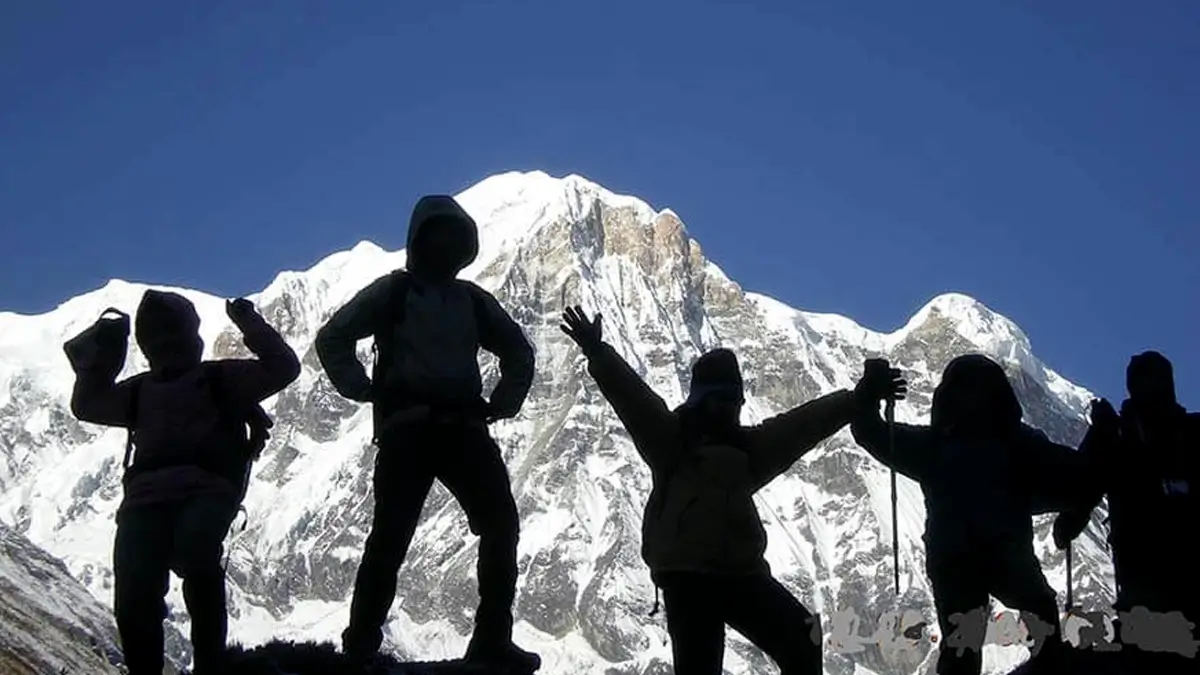
Trekkers posing on the Annapurna Circuit Trekking Trail with Mountain Monarch
Annapurna Circuit Altitude Trekking Challenges
Altitude sickness, which generally includes symptoms such as headaches, nausea, fatigue, dizziness, sudden loss of appetite, difficulty in sleeping and breathing, and also loss in balance, is the biggest concern of the trek Annapurna Circuit elevation, like on any other high Himalayan trekking and climbing journeys in Nepal, including during the Mera Peak climbing and Island Peak climbing; if ignored, it can quickly escalate to fatal conditions like HACE and HAPE.
In the remote Himalayas, where even basic facilities are things of luxury, and there is a lack of proper health care, it can get life-threatening with helicopter evacuation as the only way out, which again can be extremely costly due to a lack of proper acclimatization. But as many of the challenges that arise with the Annapurna Circuit altitude, such as extreme cold at high altitude, can also be prevented with the tips as suggested in the next paragraphs.
Essential Things to do for Managing Around the Annapurna trek altitude
First things first, proper acclimatization is a must to avoid the major round Annapurna trek height challenge, altitude sickness. Choose the Annapurna Circuit Trek itinerary that facilitates ample opportunity for proper acclimatization. Follow the golden rule whenever possible; that is, hike high and sleep low. Avoid rushing; break your journey into small, small portions, and it's highlights of the day. Eat healthy; it's good to include garlic and ginger soup.
Likewise, dehydration also often mimics the symptoms of altitude sickness, so do not forget to hydrate time and again. Avoid alcohol, though they are liquid; instead of hydrating, they are known for quickly dehydrating your body. Take rest when needed, and if you experience any such symptoms, do inform your guide immediately. Do not ascend further; the best thing to do is descend to a low region as soon as possible.
When is the Best Time for the Annapurna Circuit Altitude Trekking?
It is so that you can avoid notoriously unpredictable Himalayan weather with an increase in altitude, especially for beginners. Booking the Annapurna Circuit Trekking in spring and autumn is what we recommend. You may choose to join our fixed group departure or plan a solo, private, and family Himalayan trip in spring and autumn. March to May and September to November feature the most favorable weather, clear skies, and mild temperatures.
Seasonal challenges such as frequent rainfall in summer (monsoon) and heavy snow dumps in winter are less likely, as are the chances of flight cancellation, delays, and blockages of roads or trails due to floods, landslides, and thick snow. Instead, you get to focus on real challenges that are inherent to high-altitude treks and climbs, i.e., the Annapurna Circuit elevation trek, and make the best out of the journey with your full energy and more time.
How to stay fit for the Annapurna Circuit altitude?
Yet another key to mastering the Annapurna Circuit Trek's altitude is a good level of physical fitness. The trip is considered challenging to strenuous in terms of difficulty, especially when crossing the Thorong La Pass and in and around Tilicho Lake, though it is manageable for beginners as well. It is a must that they are fit and determined to journey through one of the remote, rugged, and less trodden parts of the Annapurna Himalayas.
Begin preparation at least 2-3 months before the official trip departure date. Focus on exercises and activities that build up your stamina, strength, and endurance. Cardio is a must to not miss. Go swimming, running, cycling, and hiking. Planks, lunges, and squats do help to enhance your muscle strength, especially for days with steep uphill climbs and downhill walks. Similarly, keep your flexibility for the basic living standards and new cultures.
What gear to pack to tackle the Annapurna Circuit altitude trekking?
Proper trekking gear and equipment ensure you stay warm and have better mobility, even when the nights can be colder, regardless of the time of year you are journeying into, as some portions get covered in snow throughout the year with the increase in Annapurna Trek height. While well broken-in high-quality trekking boots, trekking pants and T-shirts, trekking poles, first aid kits, and backpacks are basic, it is always better to carry fleece jackets and sleeping bags.
Non-technical, you may not need comprehensive climbing equipment as such as required for the Manaslu Expedition and Everest Expedition, and the exact packing list may vary based on the time of year you are journeying in; the best thing to do if you are looking forward to making it budget-friendly for a single trip is to purchase the Annapurna Circuit Trek package from Mountain Monarch. Basics are for you to arrange; for others, we provide them for you.
Conclusion
One of the defining characteristics of the legendary Himalayan adventure of the Annapurna Circuit Trek is the Annapurna trek altitude. Breathing in mountain scenery, rich cultural encounters, and crossing the Thorong La Pass on the round Annapurna trek height is what promises you an extraordinary sense of adventure and achievement, where you will get to test your skills and endurance and decide whether you are ready for long expeditions or not.
Nonetheless, if you are concerned about how high the Annapurna Circuit Trek is, it is now clear that with gradual acclimation, proper preparation, and a positive mindset, it is conquerable by healthy individuals with a good level of physical fitness without any restrictions on age and experience. Well, better approached by seasoned trekkers, it promises you an unforgettable Himalayan journey and memories to cherish for a lifetime. Book now for 2026 or 2027.